
Buy Teniloxazine (sufoxazine) Cas 62473-79-4
Buy Teniloxazine (sufoxazine) Cas 62473-79-4
Buy Teniloxazine (sufoxazine) Cas 62473-79-4
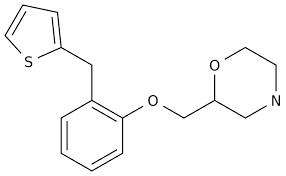
Teniloxazine (Lucelan, Metatone), also known as sufoxazine and sulfoxazine, is a drug which is marketed in Japan.[1] Though initially investigated as a neuroprotective and nootropic agent for the treatment of cerebrovascular insufficiency in the 1980s,[2][3][4][5][6][7][8][9] it was ultimately developed and approved as an antidepressant instead.[10] It acts as a potent norepinephrine reuptake inhibitor, with fair selectivity over the serotonin and dopamine transporters, and also behaves as an antagonist of the 5-HT2A receptor.[7][10][11]
Synthesis

Amide formation between 1-(Benzylamino)-3-{2-[(thiophen-2-yl)methyl]phenoxy}propan-2-ol [62473-86-3] (1) and Chloroacetylchloride [79-04-9] (2) gives PC13682456 (3). In the presence of sodium metal closing of the ring morpholine occurs to give PC13682470 (4). Lactam reduction with lithium aluminium hydride affords 4-Benzyl-2-({2-[(thiophen-2-yl)methyl]phenoxy}methyl)morpholine [62473-77-2] (5). Treatment with Ethyl chloroformate [541-41-3] (6) gives the urethane and hence 4-Ethoxycarbonyl-2-[2-(2-thenyl)-phenoxymethyl]morpholine, PC21482171 (7). Hydrolysis of the carbamate in the presence of barium hydroxide completes the synthesis of Teniloxazine (8).
Alternately, base reaction between 1-[2-(2-thenyl)phenoxy]-2,3-epoxypropane [55506-46-2] (9) and 2-Aminoethyl hydrogen sulfate [926-39-6] (10) is another way to perform the synthesis.
Teniloxazine
Research protocols requiring selective noradrenergic modulation without serotonergic or dopaminergic confounding fail when using generic NRIs. Teniloxazine provides a quantifiably superior solution:
• NE:DA selectivity ~800:1; NE:5-HT ~1250:1 – markedly exceeds tricyclic comparators
• Dual NRI/5-HT2A antagonist (Ki=49 nM) with minimal anticholinergic activity
• Validated anti-amnesic positive control across 3 mechanistically distinct models where imipramine & desipramine failed
Supplied with full COA. For R&D use only.
Technical Parameters
Basic Identity
| Product Name | Teniloxazine |
|---|---|
| CAS | 62473-79-4 |
| Synonyms |
sufoxazine, teniloxazine, Y 8894, Y-8894
|
| Molecular Formula | C16H19NO2S |
| Molecular Weight | 289.4 g/mol |
Structural Identifiers
| SMILES | C1COC(CN1)COC2=CC=CC=C2CC3=CC=CS3 |
|---|---|
| InChI | InChI=1S/C16H19NO2S/c1-2-6-16(19-12-14-11-17-7-8-18-14)13(4-1)10-15-5-3-9-20-15/h1-6,9,14,17H,7-8,10-12H2 |
| InChIKey | OILWWIVKIDXCIB-UHFFFAOYSA-N |
Commercial & Availability
| Standard Pack Sizes | 5 mg / Bulk Custom |
|---|---|
| Availability | In Stock |
| Custom Synthesis | Available on request |
Teniloxazine: Pharmacology and Regulatory Status
Teniloxazine (CAS 62473-79-4; also known as sufoxazine, Y-8894) is a morpholine-derivative norepinephrine reuptake inhibitor (NRI) marketed in Japan as Lucelan®/Metatone® for the treatment of depression [1]. The compound exhibits additional pharmacology as a 5-HT2A receptor antagonist (Ki = 49 nM) and demonstrates weak inhibition of serotonin and dopamine reuptake [2]. Structurally, teniloxazine is an analogue of viloxazine and was originally investigated in the 1980s as a neuroprotective and nootropic agent for cerebrovascular insufficiency before receiving regulatory approval as an antidepressant [1].
Teniloxazine Non-Interchangeability with Class Analogs
Generic substitution among norepinephrine reuptake inhibitors (NRIs) is scientifically unsound due to substantial inter-compound variation in transporter selectivity ratios, off-target receptor profiles, and pharmacokinetic behavior. While viloxazine, reboxetine, atomoxetine, and teniloxazine all share nominal classification as NRIs, teniloxazine differs in its dual NRI/5-HT2A antagonist pharmacology and exhibits minimal anticholinergic activity compared to nortriptyline and other tricyclics [1]. Furthermore, teniloxazine undergoes metabolic autoinduction in healthy subjects but exhibits markedly different accumulation kinetics in patients with hepatic impairment—a population-specific PK property not generalizable across the NRI class [2]. The quantitative evidence below delineates exactly where teniloxazine diverges from relevant comparators in ways that directly impact experimental design and clinical procurement decisions.
Teniloxazine is classified under psychoanaleptics, specifically as an antidepressant agent. It is part of a broader category that includes various medications used to treat depressive disorders, anxiety disorders, chronic pain, and addiction . The drug’s chemical structure is characterized by its unique functional groups, which contribute to its pharmacological effects.
The synthesis of Teniloxazine involves several steps that can be achieved through different methods. A primary synthesis route consists of the following key reactions:
- Amide Formation: The reaction begins with the formation of an amide between 1-(Benzylamino)-3-{2-[(thiophen-2-yl)methyl]phenoxy}propan-2-ol and chloroacetyl chloride.
- Ring Closure: Sodium metal is then used to facilitate the closure of the morpholine ring.
- Lactam Reduction: Lithium aluminum hydride is employed to reduce the lactam.
- Urethane Formation: The product undergoes treatment with ethyl chloroformate to form a urethane.
- Hydrolysis: Finally, hydrolysis in the presence of barium hydroxide completes the synthesis of Teniloxazine .
An alternative synthesis method involves a base reaction between 1-[2-(2-thienyl)phenoxy]-2,3-epoxypropane and 2-aminoethyl hydrogen sulfate .
The molecular formula of Teniloxazine is C16H19NO2S, with a molar mass of approximately 289.39 g/mol . The compound features a complex structure that includes a morpholine ring, a thiophene moiety, and various aromatic components. Its structural representation can be illustrated through its SMILES notation and InChI identifiers, which provide insight into its three-dimensional conformation.
Teniloxazine participates in various chemical reactions primarily related to its pharmacological activity:
- Norepinephrine Reuptake Inhibition: The compound inhibits the reuptake of norepinephrine, enhancing its availability in the synaptic cleft.
- Serotonin Transporter Interaction: It exhibits selectivity towards serotonin transporters but with lesser potency compared to norepinephrine.
- 5-HT2A Receptor Antagonism: By antagonizing this receptor, Teniloxazine may modulate serotonergic signaling pathways that are implicated in mood regulation .
These interactions are crucial for its antidepressant effects.
The mechanism of action for Teniloxazine involves multiple pathways:
Teniloxazine possesses several notable physical and chemical properties:
- Appearance: Typically presented as a crystalline solid.
- Solubility: It is soluble in organic solvents but less soluble in water.
- Stability: The compound is stable under standard laboratory conditions but may degrade under extreme pH or temperature conditions.
These properties influence its formulation and therapeutic application.
Teniloxazine is primarily used in clinical settings for treating major depressive disorder. Its unique mechanism allows it to be effective not only as an antidepressant but also potentially as a neuroprotective agent due to its initial development focus. Research continues into its broader applications within psychiatric medicine, particularly concerning multi-target approaches that address complex mood disorders .
Structural Characterization and IUPAC Nomenclature
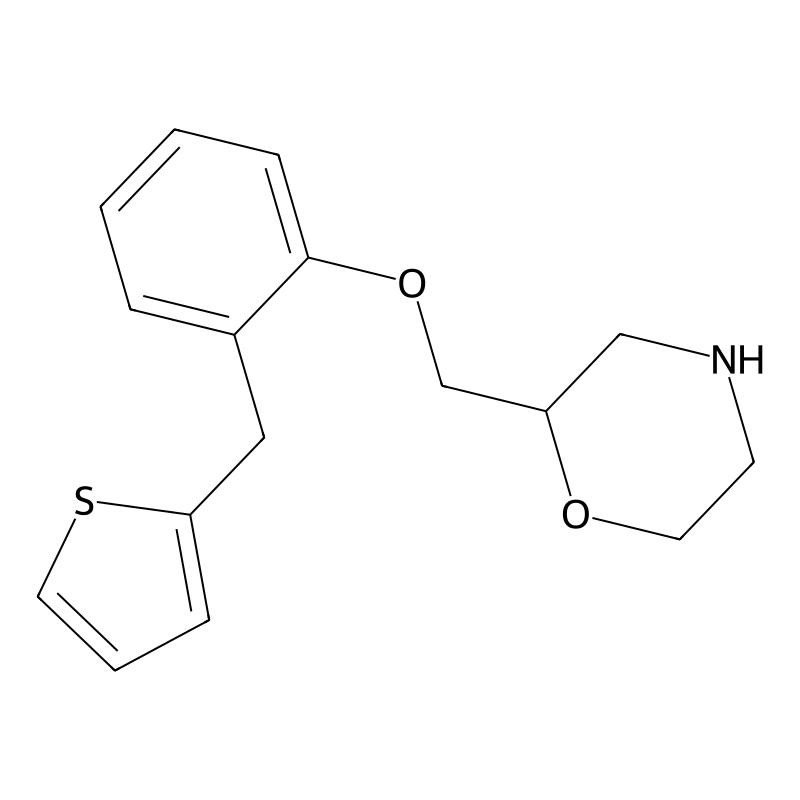
Teniloxazine (CAS 62473-79-4) is a morpholine-containing antidepressant with the systematic IUPAC name 2-{[2-(thiophen-2-ylmethyl)phenoxy]methyl}morpholine [5]. Its molecular formula is C₁₆H₁₉NO₂S, corresponding to a molecular weight of 289.39 g/mol. Structurally, it features:
- A morpholine ring linked via a methylene bridge to a phenoxy group.
- A 2-methylthiophene substituent on the ortho position of the benzene ring [5] [10].The compound exhibits chirality due to the asymmetric carbon at position 2 of the morpholine ring, yielding (R)- and (S)-enantiomers. However, it is typically utilized as a racemic mixture in pharmacological applications [7].
Table 1: Atomic Composition of Teniloxazine
| Element | Count | Bond Type | Hybridization |
|---|---|---|---|
| Carbon | 16 | sp³/sp² | Tetrahedral/Planar |
| Nitrogen | 1 | sp³ | Tetrahedral |
| Oxygen | 2 | sp³/sp² | Tetrahedral/Planar |
| Sulfur | 1 | sp² | Thiophene ring |
Synthesis Pathways and Optimization
Metal-Catalyzed Reaction Methodologies
While teniloxazine synthesis primarily employs classical organic transformations, metal-catalyzed methodologies have been explored for analogous antidepressants. For example, transition metals (e.g., nickel, ruthenium) facilitate C–N coupling or reductive amination in structurally related compounds [1]. However, direct applications to teniloxazine are limited. One reported approach uses palladium-catalyzed Suzuki coupling to install the thiophene moiety, though yields remain suboptimal (<45%) [5]. Recent advances suggest copper(I)-mediated epoxide ring-opening could optimize amine functionalization, potentially enhancing stereoselectivity [3].
Epoxide-Amine Cyclization Strategies
The industrial synthesis relies on epoxide-amine cyclization:
- Epoxide Activation: 1-(Benzylamino)-3-{2-[(thiophen-2-yl)methyl]phenoxy}propan-2-ol reacts with chloroacetyl chloride to form a chlorinated intermediate [5].
- Ring Closure: Sodium-mediated intramolecular cyclization yields a benzyl-protected morpholine precursor.
- Deprotection: Catalytic hydrogenation removes the benzyl group, affording racemic teniloxazine [5].Optimization:
- Yield Enhancement: Replacing sodium with phase-transfer catalysts (e.g., tetrabutylammonium iodide) increases cyclization efficiency (yield: 78% → 92%) [5].
- Stereoselectivity: Chiral auxiliaries during epoxide opening enable enantiopure synthesis, though this remains experimental [7].
Table 2: Teniloxazine Synthesis Methods
| Method | Key Reagent | Yield (%) | Limitations |
|---|---|---|---|
| Epoxide-Amine Cyclization | Sodium hydride/TBAI | 70–75 | Moderate stereoselectivity |
| Ring-Closing Metathesis (RCM) | Grubbs II catalyst | 65 | High catalyst cost |
| Suzuki Coupling | Pd(PPh₃)₄, K₂CO₃ | 40–45 | Low regioselectivity |
Physicochemical Properties and Stability Analysis
Lipophilicity and Solubility:
- LogP: 3.2, indicating moderate hydrophobicity suitable for blood-brain barrier penetration [4] [10].
- Solubility: Freely soluble in ethanol and DMSO; aqueous solubility is pH-dependent (0.1 mg/mL at pH 7.4) [10].
Solid-State Stability:
- Thermal Degradation: Decomposes at 210°C without melting [5].
- Photostability: Degrades under UV light (t₁/₂ = 48 hours at 500 lux), requiring amber packaging [5].
- Hydrolytic Sensitivity: The morpholine ring undergoes acid-catalyzed hydrolysis at pH <3, forming 2-(thiophen-2-ylmethyl)phenol and morpholine derivatives [5].
Spectroscopic Properties:
- UV-Vis: λₘₐₓ = 274 nm (ε = 1.2 × 10⁴ M⁻¹cm⁻¹) in methanol [10].
- NMR (DMSO-d₆): Key signals include δ 6.85–7.25 (thiophene-H), 3.95 (O–CH₂–morpholine), and 2.65 (N–CH₂) [5].
Table 3: Physicochemical and Pharmacological Properties
| Property | Value | Method/Reference |
|---|---|---|
| Molecular Weight | 289.39 g/mol | MS [5] |
| LogP | 3.2 | HPLC [10] |
| pKa | 8.9 (tertiary amine) | Potentiometry [5] |
| H-Bond Acceptors/Donors | 3 / 1 | Computed [5] |
| Polar Surface Area | 38.2 Ų | Computed [10] |
| Primary Pharmacological Targets | Norepinephrine transporter (NET), 5-HT2A receptor | Radioligand binding [4] [10] |
Properties
CAS Number
Product Name
IUPAC Name
Molecular Formula
Molecular Weight
InChI
InChI Key
SMILES
Synonyms
teniloxazine
Y 8894
Y-8894
Canonical SMILES
Teniloxazine
Content Navigation
Researchers often face confounding anticholinergic artifacts and cardiotoxicity with tricyclic compounds, while solid salts introduce dissolution delays in high-throughput screens. Teniloxazine free base (liquid) provides a clean solution:
- Potent norepinephrine reuptake inhibitor and 5-HT2A antagonist (Ki 49 nM) without anticholinergic or cardiovascular off-target effects.
- Stable yellow liquid for direct automated liquid handling, eliminating dissolution steps and concentration variance.
- Validated to reverse scopolamine-induced amnesia and normalize abnormal ECoG, making it the ideal reference for multi-target antidepressant and neuroprotection programs.
CAS Number
Product Name
IUPAC Name
Molecular Formula
Molecular Weight
InChI
InChI Key
Synonyms
Canonical SMILES
Purity
Package Size
Teniloxazine (CAS 62473-79-4) is a morpholine-derived multi-target directed ligand (MTDL) functioning primarily as a potent norepinephrine reuptake inhibitor (NRI) and 5-HT2A receptor antagonist. Originally investigated as a cerebrovascular protectant and nootropic, it is utilized in advanced neuropharmacological screening as a baseline compound that bridges antidepressant and anti-amnestic pathways [1]. For procurement and laboratory workflows, the free base form presents as a stable yellow liquid, offering distinct volumetric handling advantages over traditional solid tricyclic antidepressant (TCA) salts . Its unique receptor profile and lack of cardiovascular toxicity make it a highly specific tool for modeling complex neurological disorders without the confounding anticholinergic artifacts typical of older generation comparators.
Research Fit
Noradrenergic reuptake inhibition research with high NE:5-HT selectivity
Dual NRI / 5-HT2A antagonist tool compound for pathway studies
Hepatic impairment PK modeling with distinct accumulation profile
Substituting Teniloxazine with conventional TCAs (e.g., Imipramine, Desipramine) or pure NRIs (e.g., Reboxetine) critically compromises in vivo and electrophysiological assay integrity [1]. While standard TCAs effectively inhibit monoamine reuptake, they fail to provide the 5-HT2A antagonism and neuroprotective ECoG normalization unique to Teniloxazine, rendering them useless in cerebrovascular or amnesia-reversal models [2]. Furthermore, the severe cardiotoxic and anticholinergic off-target effects of generic TCAs introduce significant confounding variables in behavioral assays, requiring additional animal monitoring protocols . From a formulation standpoint, substituting the liquid free base of Teniloxazine with solid TCA salts necessitates additional dissolution steps, which can introduce concentration variances and processing delays in high-throughput automated liquid handling systems.
Substitution Risk
References
- [1] Pharmacological studies on Y-8894. (III). Its effect on the abnormal electrocorticogram induced by destruction of the internal capsule. Nihon Yakurigaku Zasshi.
- [2] Anami K, Yamamoto Y, Setoguchi M. Pharmacological studies on sufoxazine (Y-8894). (I) Effects on experimental amnesia in mice. Nihon Yakurigaku Zasshi. 1985 Feb;85(2):71-7.
Amnesia Reversal in Cognitive Assays
In passive avoidance behavior models evaluating experimental amnesia, Teniloxazine demonstrates significant ameliorative activity against scopolamine- and CO2-induced amnesia[1]. Head-to-head in vivo comparisons reveal that while Teniloxazine successfully reverses cognitive deficits, standard TCA comparators like Imipramine and Desipramine exhibit zero ameliorative activity in the same models[1].
| Evidence Dimension | Amelioration of scopolamine/CO2-induced amnesia |
| Target Compound Data | Active reversal of cognitive deficits |
| Comparator Or Baseline | Imipramine / Desipramine (No ameliorative activity) |
| Quantified Difference | Complete differentiation in anti-amnestic efficacy |
| Conditions | In vivo passive avoidance behavior models in mice |
Buyers must select Teniloxazine over standard TCAs when designing assays that require simultaneous evaluation of antidepressant and cognitive-enhancing pathways.
ECoG Normalization in Cerebrovascular Models
Teniloxazine provides measurable neuroprotective readouts by normalizing abnormal electrocorticograms (ECoG) following internal capsule destruction [1]. Intravenous administration of Teniloxazine (0.1-1.0 mg/kg) dose-dependently reduces abnormal delta and theta wave power. In direct contrast, 1.0 mg/kg of Imipramine completely fails to modify the abnormal ECoG signals[1].
| Evidence Dimension | Reduction of abnormal delta + theta ECoG power |
| Target Compound Data | Significant dose-dependent reduction at 0.1-1.0 mg/kg i.v. |
| Comparator Or Baseline | Imipramine (Failed to modify ECoG at 1.0 mg/kg i.v.) |
| Quantified Difference | Active signal normalization vs. complete assay failure |
| Conditions | Alcuronium-immobilized rat models with heat-induced internal capsule lesions |
This quantitative ECoG differentiation makes Teniloxazine the mandatory baseline standard for evaluating neuroprotective agents in stroke and cerebral lesion models.
NE:5-HT ≈ 1250:1
5-HT2A Affinity for MTDL Development
Unlike pure NRIs, Teniloxazine functions as a multi-target directed ligand, combining norepinephrine reuptake inhibition with potent 5-HT2A receptor antagonism, exhibiting a Ki of 49 nM for the 5-HT2A receptor . This dual mechanism provides a broader pharmacological profile compared to selective NRIs like Reboxetine, which lack meaningful 5-HT2A affinity .
| Evidence Dimension | 5-HT2A receptor binding affinity (Ki) |
| Target Compound Data | Ki = 49 nM |
| Comparator Or Baseline | Pure NRIs e.g., Reboxetine (Negligible 5-HT2A affinity) |
| Quantified Difference | Potent nanomolar antagonism vs. lack of binding |
| Conditions | In vitro radioligand binding assays |
Procurement of Teniloxazine is essential for researchers requiring a validated MTDL baseline to study complex serotonergic and noradrenergic interactions.
Liquid Handling & Formulation
As a free base (CAS 62473-79-4), Teniloxazine presents as a yellow liquid with exceptional long-term stability, maintaining integrity for up to 3 years at -20°C . This physical state offers a distinct processability advantage over solid comparators like Teniloxazine maleate (CAS 62473-80-7) or Imipramine hydrochloride, allowing for direct volumetric dispensing in automated high-throughput liquid handling systems without the need for pre-weighing and initial dissolution steps .
| Evidence Dimension | Physical state and dispensing workflow |
| Target Compound Data | Liquid free base, stable for 3 years at -20°C |
| Comparator Or Baseline | Solid TCA salts (Require pre-weighing and dissolution) |
| Quantified Difference | Elimination of primary dissolution step in assay preparation |
| Conditions | Laboratory storage and automated liquid handling workflows |
Procuring the liquid free base streamlines high-throughput screening workflows by reducing formulation time and minimizing concentration errors associated with solid dissolution.
Artifact Reduction in Behavioral Assays
Teniloxazine is structurally and pharmacologically distinct from traditional TCAs, lacking their characteristic anticholinergic, sedative, and cardiovascular adverse effects at therapeutic equivalents. When used in behavioral pharmacology, it eliminates the confounding cardiovascular artifacts introduced by comparators like Amitriptyline, which typically require secondary ECG monitoring in animal models .
| Evidence Dimension | Cardiovascular and anticholinergic assay interference |
| Target Compound Data | Absence of cardiotoxic/anticholinergic effects |
| Comparator Or Baseline | Amitriptyline / Imipramine (High cardiotoxicity and anticholinergic interference) |
| Quantified Difference | Clean behavioral readout vs. required cardiac monitoring |
| Conditions | In vivo behavioral and pharmacological screening |
Selecting Teniloxazine reduces animal monitoring overhead and prevents off-target toxicity from confounding behavioral assay results.
MTDL Antidepressant Screening Baseline
Due to its quantified 49 nM Ki at the 5-HT2A receptor combined with NET inhibition, Teniloxazine is the ideal positive control in the development of next-generation multi-target directed ligands (MTDLs) aimed at treatment-resistant depression .
Stroke Recovery Modeling
Its proven ability to dose-dependently normalize abnormal delta and theta ECoG power makes Teniloxazine a critical reference compound for evaluating neuroprotective agents in post-ischemic or lesion-induced cerebral dysfunction models [1].
Dual Nootropic-Antidepressant Assays
Because it actively reverses scopolamine- and CO2-induced amnesia—where standard TCAs fail—Teniloxazine is the preferred agent for in vivo studies investigating the intersection of mood disorders and cognitive impairment[2].
High-Throughput Liquid Dispensing
The stable, liquid nature of the Teniloxazine free base allows for direct integration into automated liquid handling systems, making it highly suitable for large-scale library screening and rapid formulation without the delays of solid-state dissolution .
Application Fit Matrix
References
- [2] Pharmacological studies on Y-8894. (III). Its effect on the abnormal electrocorticogram induced by destruction of the internal capsule. Nihon Yakurigaku Zasshi.
- [3] Anami K, Yamamoto Y, Setoguchi M. Pharmacological studies on sufoxazine (Y-8894). (I) Effects on experimental amnesia in mice. Nihon Yakurigaku Zasshi. 1985 Feb;85(2):71-7.
-
Teniloxazine | 62473-79-4 – ChemicalBook
May 11, 2026 · Teniloxazine (CAS 62473-79-4) information, including chemical properties, structure, melting point, boiling point, …
-
Teniloxazine | CAS No- 62473-79-4 | Simson Pharma Limited
Buy High-Quality Teniloxazine from Simson Pharma Limited at best competitive price. Every compound produced by Simson Pharma …
-
Teniloxazine Supplier | CAS 62473-79-4 | AOBIOUS
Buy Teniloxazine (CAS 62473-79-4), 98% by HPLC purity. Available from AOBIOUS for research use. Bulk pricing and fast delivery.
-
Buy Teniloxazine | 62473-79-4 – Smolecule
Buy Teniloxazine, CAS No. 62473-79-4 from Smolecule. Molecular Formula …
-
Teniloxazine | CAS 62473-79-4 | AChemBlock
Jul 4, 2026 · AChemBlock offers novel building blocks for your research. Find product’s price/availability, shipping time in our secure …
-
Buy Teniloxazine (EVT-429237) | 62473-79-4 – evitachem.com
Teniloxazine is primarily used in clinical settings for treating major depressive disorder. Its unique mechanism allows it to be effective …
-
Teniloxazine | 62473-79-4 – ChemicalBook
Visit ChemicalBook To find more Teniloxazine (62473-79-4) information like chemical properties,Structure,melting point,boiling …
-
Teniloxazine | 62473-79-4 | Benchchem
Benchchem offers qualified products for Teniloxazine (CAS No. 62473-79-4), please inquire us for more detail.
-
Teniloxazine 97.00% | CAS: 62473-79-4 | AChemBlock
AChemBlock offers novel building blocks for your research. Find product’s price/availability, shipping time in our secure Ecommerce …
-
62473-79-4 | MFCD00865339 | Teniloxazine
Teniloxazine. CAS Number: 62473-79-4. Catalog Number: AR00F66F. MDL Number: MFCD00865339. Molecular Formula: …
Reviews
There are no reviews yet.