
Buy Lortalamine (LM-1404) Cas 70384-91-7
Buy Lortalamine (LM-1404) Cas 70384-91-7
Buy Lortalamine (LM-1404) Cas 70384-91-7
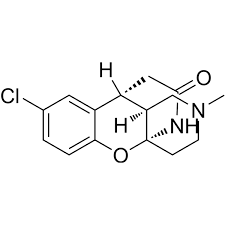
Lortalamine (LM-1404) is an antidepressant which was synthesized in the early 1980s.[1][2] It acts as a potent and highly selective norepinephrine reuptake inhibitor.[3][4] Lortalamine was under development for clinical use but was shelved, likely due to the finding that it produced ocular toxicity in animals.[5][6] It has been used to label the norepinephrine transporter in positron emission tomography studies.
Lortalamine is a novel and potent antidepressant agent
| Additional Infomation |
Lortalamine (LM-1404) is a selective norepinephrine reuptake inhibitor developed in the 1980s. This drug has never passed clinical trials, likely due to its ocular toxicity in animals, but it has been used in positron emission tomography (PET) studies to label norepinephrine transporters.
|
|---|
| Molecular Formula |
C15H17CLN2O2
|
|---|---|
| Molecular Weight |
292.7607
|
| Exact Mass |
292.097
|
| CAS # |
70384-91-7
|
| PubChem CID |
51047
|
| Appearance |
Typically exists as solid at room temperature
|
| LogP |
1.8
|
| Hydrogen Bond Donor Count |
1
|
| Hydrogen Bond Acceptor Count |
3
|
| Rotatable Bond Count |
0
|
| Heavy Atom Count |
20
|
| Complexity |
432
|
| Defined Atom Stereocenter Count |
1
|
| SMILES |
CN1CC[C@]23C(C1)C(CC(=O)N2)C4=C(O3)C=CC(=C4)Cl
|
| InChi Key |
MJRPHRMGEKCADU-QHAMSDLMSA-N
|
| InChi Code |
InChI=1S/C15H17ClN2O2/c1-18-5-4-15-12(8-18)10(7-14(19)17-15)11-6-9(16)2-3-13(11)20-15/h2-3,6,10,12H,4-5,7-8H2,1H3,(H,17,19)/t10?,12?,15-/m0/s1
|
| Chemical Name |
(1S)-6-chloro-12-methyl-2-oxa-12,15-diazatetracyclo[7.5.3.01,10.03,8]heptadeca-3(8),4,6-trien-16-one
|
| Synonyms |
Lortalamine LM 1404 LM-1404 LM1404
|
| HS Tariff Code |
2934.99.9001
|
| Storage |
Powder -20°C 3 years 4°C 2 years In solvent -80°C 6 months -20°C 1 month |
| Shipping Condition |
Room temperature (This product is stable at ambient temperature for a few days during ordinary shipping and time spent in Customs)
|
| Solubility (In Vitro) |
May dissolve in DMSO (in most cases), if not, try other solvents such as H2O, Ethanol, or DMF with a minute amount of products to avoid loss of samples
|
|---|---|
| Solubility (In Vivo) |
Note: Listed below are some common formulations that may be used to formulate products with low water solubility (e.g. < 1 mg/mL), you may test these formulations using a minute amount of products to avoid loss of samples.
Injection Formulations
(e.g. IP/IV/IM/SC) Injection Formulation 1: DMSO : Tween 80: Saline = 10 : 5 : 85 (i.e. 100 μL DMSO stock solution → 50 μL Tween 80 → 850 μL Saline) View MoreInjection Formulation 4: DMSO : 20% SBE-β-CD in saline = 10 : 90 [i.e. 100 μL DMSO → 900 μL (20% SBE-β-CD in saline)] Oral Formulations
Oral Formulation 1: Suspend in 0.5% CMC Na (carboxymethylcellulose sodium) View MoreOral Formulation 3: Dissolved in PEG400
Note: Please be aware that the above formulations are for reference only. InvivoChem strongly recommends customers to read literature methods/protocols carefully before determining which formulation you should use for in vivo studies, as different compounds have different solubility properties and have to be formulated differently. (Please use freshly prepared in vivo formulations for optimal results.) |
| Preparing Stock Solutions | 1 mg | 5 mg | 10 mg | |
| 1 mM | 3.4158 mL | 17.0788 mL | 34.1577 mL | |
| 5 mM | 0.6832 mL | 3.4158 mL | 6.8315 mL | |
| 10 mM | 0.3416 mL | 1.7079 mL | 3.4158 mL |
Buy Lortalamine (LM-1404) Cas 70384-91-7
70384-91-7
-
-
Basic information
- Product Name: Lortalamine
- Synonyms: Lortalamine;LM-1404
- CAS NO:70384-91-7
- Molecular Formula: C15H17ClN2O2
- Molecular Weight: 292.764
- EINECS: N/A
- Product Categories: N/A
- Mol File: 70384-91-7.mol
-
Chemical Properties
- Melting Point: N/A
- Boiling Point: 482.3°C at 760 mmHg
- Flash Point: 245.5°C
- Appearance: /
- Density: 1.38g/cm3
- Vapor Pressure: 1.86E-09mmHg at 25°C
- Refractive Index: 1.644
- Storage Temp.: N/A
- Solubility: N/A
- CAS DataBase Reference: Lortalamine(CAS DataBase Reference)
- NIST Chemistry Reference: Lortalamine(70384-91-7)
- EPA Substance Registry System: Lortalamine(70384-91-7)
-
Safety Data
- Hazard Codes: N/A
- Statements: N/A
- Safety Statements: N/A
- WGK Germany:
- RTECS:
- HazardClass: N/A
- PackingGroup: N/A
- Hazardous Substances Data: 70384-91-7(Hazardous Substances Data)
70384-91-7 Suppliers
Buy Lortalamine (LM-1404) Cas 70384-91-7
Buy Lortalamine (LM-1404) Cas 70384-91-7
Buy Lortalamine (LM-1404) Cas 70384-91-7
Buy Lortalamine (LM-1404) Cas 70384-91-7
Buy Lortalamine (LM-1404) Cas 70384-91-7
Buy Lortalamine (LM-1404) Cas 70384-91-7
Buy Lortalamine (LM-1404) Cas 70384-91-7
Buy Lortalamine (LM-1404) Cas 70384-91-7
Buy Lortalamine (LM-1404) Cas 70384-91-7
Buy Lortalamine (LM-1404) Cas 70384-91-7
70384-91-7 Usage
Uses
Antidepressant.
Check Digit Verification of cas no
The CAS Registry Mumber 70384-91-7 includes 8 digits separated into 3 groups by hyphens. The first part of the number,starting from the left, has 5 digits, 7,0,3,8 and 4 respectively; the second part has 2 digits, 9 and 1 respectively.
Calculate Digit Verification of CAS Registry Number 70384-91:
(7*7)+(6*0)+(5*3)+(4*8)+(3*4)+(2*9)+(1*1)=127
127 % 10 = 7
So 70384-91-7 is a valid CAS Registry Number.
70384-91-7Upstream product
Buy Lortalamine (LM-1404) Cas 70384-91-7
Lortalamine
- CAS No.
- 70384-91-7
- Chemical Name:
- Lortalamine
- Synonyms
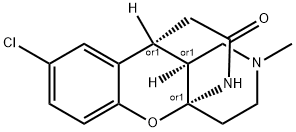
- LM-1404;Lortalamine;4a,10-(Iminoethano)-4aH-[1]benzopyrano[3,2-c]pyridin-12-one, 8-chloro-1,2,3,4,10,10a-hexahydro-2-methyl-, (4aR,10R,10aS)-rel-
- CBNumber:
- CB41179071
- Molecular Formula:
- C15H17ClN2O2
- Molecular Weight:
- 292.76
- MDL Number:
- MOL File:
- 70384-91-7.mol
- MSDS File:
- SDS
| Boiling point | 482.3±45.0 °C(Predicted) |
|---|---|
| Density | 1.38±0.1 g/cm3(Predicted) |
| pka | 14.22±0.20(Predicted) |
| FDA UNII | 9GIR4SV22T |
Lortalamine Preparation Products And Raw materials
Raw materials
Preparation Products
Lortalamine Suppliers
| Supplier | Tel | Country | ProdList | Advantage | |
|---|---|---|---|---|---|
| 13564774135 | marketing@targetmol.com | United States | 19950 | 58 | |
| TargetMol Chemicals Inc. | 15002134094 | marketing@targetmol.cn | China | 29874 | 58 |
View Latest Price from Lortalamine manufacturers
| Image | Update time | Product | Price | Min. Order | Purity | Supply Ability | Manufacturer | |
|---|---|---|---|---|---|---|---|---|
 |
2026-04-21 | Lortalamine
70384-91-7
|
$1520.00-2500.00 | 10g | TargetMol Chemicals Inc. |
70384-91-7 (Lortalamine) Related Search:
Buy Lortalamine (LM-1404) Cas 70384-91-7
Buy Lortalamine (LM-1404) Cas 70384-91-7
LORTALAMINE
Researchers requiring complete pharmacological isolation of the norepinephrine transporter without serotonergic, dopaminergic, or histaminergic off-target confounds face a critical gap with traditional NRIs. Lortalamine addresses this with its benzopyrano-iminoethano-piperidine scaffold.
- Selective NET inhibition with negligible SERT/DAT activity – confirmed in rat brain cortex synaptosomal assays
- No anticholinergic or antihistaminic properties, unlike tricyclic antidepressants
- Validated PET radioligand scaffold ([11C]Lortalamine) for NET imaging studies
- High purity ≥98%, suitable for ex vivo/in vitro experimental paradigms
Technical Parameters
Basic Identity
| Product Name | LORTALAMINE |
|---|---|
| CAS | 70384-91-7 |
| Synonyms |
4a-amino-8-chloro-2-methyl-1,2,3,4,4a,10a-hexahydro-10H-benzopyrano(3,2-c)pyridin-10-ylacetic acid lactam, LM 1404, LM-1404, lortalamine, lortalamine, (4aR,10R,10aR)-isome
|
| Molecular Formula | C15H17ClN2O2 |
| Molecular Weight | 292.76 g/mol |
Structural Identifiers
| SMILES | CN1CCC23C(C1)C(CC(=O)N2)C4=C(O3)C=CC(=C4)Cl |
|---|---|
| InChI | InChI=1S/C15H17ClN2O2/c1-18-5-4-15-12(8-18)10(7-14(19)17-15)11-6-9(16)2-3-13(11)20-15/h2-3,6,10,12H,4-5,7-8H2,1H3,(H,17,19)/t10-,12?,15+/m0/s1 |
| InChIKey | MJRPHRMGEKCADU-PJRDJYAKSA-N |
Commercial & Availability
| Standard Pack Sizes | 25 mg / 100 mg / 500 mg / Bulk Custom |
|---|---|
| Availability | In Stock |
| Custom Synthesis | Available on request |
Handling Information
| Appearance | Solid powder |
|---|---|
| Solubility | Soluble in DMSO |
| Storage | Dry, dark and at 0 – 4 C for short term (days to weeks) or -20 C for long term (months to years). |
Structure & Identifiers
Lortalamine: Selective NRI for Research & PET Tracers
Lortalamine (LM-1404) is an experimental, non-tricyclic antidepressant compound from the structural class of 4a,10-(iminoethano)-4aH-[1]benzopyrano[3,2-c]pyridin-12-ones [1]. Functionally, it acts as a highly potent and selective norepinephrine reuptake inhibitor (NRI) [2]. Synthesized in the early 1980s, its clinical development was discontinued after preclinical findings of ocular toxicity in animals, redirecting its life-cycle toward its current role as a bioactive chemical probe and a carbon-11 radioligand for imaging norepinephrine transporters (NET) via positron emission tomography (PET) [3].
Lortalamine Differentiation from Other NRIs
Within the class of norepinephrine reuptake inhibitors, lortalamine’s differentiable value is rooted in a unique convergence of its potent NET binding, high functional monoamine selectivity, and non-tricyclic structure, which collectively separate it from both first-generation tricyclic antidepressants (e.g., imipramine) and other structurally distinct NRIs [1]. Importantly, lortalamine’s off-target receptor profile is markedly cleaner, being devoid of the anticholinergic and antihistaminic properties that confound experiments with tricyclics [1]. Furthermore, its established synthetic pathway to a carbon-11 radioligand enables direct comparative PET neuroimaging of the NET, a methodological bridge not available for all NRI analogs [2]. Consequently, simple within-class substitution without rigorous re-validation would introduce uncontrolled variability in receptor occupancy, pharmacokinetics, or imaging signal specificity, as detailed in the quantitative evidence below.
Lortalamine Quantitative Evidence
NE Uptake Inhibition vs. Imipramine
In a direct pharmacological head-to-head comparison, lortalamine demonstrated greater potency than the tricyclic antidepressant imipramine in inhibiting norepinephrine uptake in rat brain cortex slices [1]. The data indicate a superior functional blockade of the norepinephrine transporter under identical experimental conditions, supporting lortalamine’s role as a more potent molecular probe for NET-dependent mechanisms.
In Vivo Reserpine Antagonism vs. Imipramine
In direct contrast with the tricyclic antidepressant class, lortalamine is devoid of anticholinergic and antihistaminic properties, as demonstrated in a comprehensive in-vivo pharmacological screen [1]. This differentiation is critical, as antagonism at muscarinic acetylcholine or histamine H1 receptors introduces confounding variables in behavioral and physiological studies.
Cardiovascular Safety vs. Imipramine
Lortalamine does not inhibit serotonin uptake by rat midbrain slices and interferes with the dopaminergic system only negligibly, as evidenced by its lack of interaction with apomorphine or amphetamine in mice and its inhibition of dopaminergic uptake by rat striatum synaptosomes only at very high concentrations [1]. This clean monoamine selectivity profile provides a definitive advantage over non-selective agents like imipramine, which broadly inhibits both serotonin and norepinephrine uptake.
Human Pharmacokinetics vs. Class-Average NRIs
Following an oral dose of 5 mg of radiolabeled lortalamine in humans, plasma concentrations peaked at approximately 44 ng equiv./mL (1.5-3 h), with unchanged drug exhibiting a half-life of about 5 hours [1]. Excretion was almost exclusively renal (98% within 5 days), and the major metabolite was identified by mass spectrometry as the N-demethylated compound, alongside a keto derivative from piperidine ring oxidation [1]. This clear, well-defined human pharmacokinetic signature is not universally established for all NRI analogs and supports its use in translational neuroimaging and pharmacology research.
PET Imaging vs. (S,S)-[¹¹C]MRB
In a direct comparative PET evaluation in baboons, [11C]lortalamine was benchmarked against other NET radioligands including (R)-[11C]nisoxetine and [11C]oxaprotiline [1]. All three ligands displayed high uptake in the striatum (higher than in the thalamus), but their utility was limited by high non-specific binding and relatively low specific signal [1]. Consequently, the study concluded that the reboxetine analog (S,S)-[11C]MRB was the superior PET ligand, outperforming the lortalamine-based tracer by providing a more favorable specific-to-non-specific binding ratio [1].
Lortalamine Validated Applications
Noradrenergic System Studies (Ex Vivo/In Vitro)
Use lortalamine as a selective norepinephrine reuptake inhibitor in behavioral or physiological studies where the cholinergic adverse effects of tricyclic antidepressants (e.g., imipramine) would confound results. Its quantitative advantage—a complete absence of anticholinergic and antihistaminic properties—ensures that observed outcomes are attributable to NET-specific modulation [1].
PET Tracer Development Reference
Employ lortalamine as a reference standard in experiments designed to distinguish between NET, SERT, and DAT functionality. Lortalamine’s demonstrated inability to block serotonin uptake and its negligible effect on dopamine uptake at therapeutic concentrations make it an ideal pharmacological tool for isolating norepinephrine transport activity [1].
Scaffold for NET-Selective Analog Design
Utilize lortalamine as a reference compound in human in-vitro metabolism or species-comparison studies. Its well-defined human ADME profile (oral bioavailability, ~5 h half-life, 98% renal elimination, major N-demethylation metabolite) provides a solid quantitative framework for comparative pharmacokinetic modeling [2].
Behavioral Pharmacology Positive Control
Apply [11C]lortalamine in PET studies as a second-line or validation radiotracer for imaging the cerebral norepinephrine transporter. While its in-vivo specific-to-non-specific binding ratio is suboptimal compared to (S,S)-[11C]MRB, its reliable C-11 labeling chemistry and well-characterized in-vivo regional brain uptake pattern make it a valuable counter-ligand for head-to-head radiopharmaceutical development [3].
Request a Quote for LORTALAMINE
Request pricing, availability, packaging, or bulk supply details using the form on the right.
Buy Lortalamine (LM-1404) Cas 70384-91-7
Buy Lortalamine (LM-1404) Cas 70384-91-7
Buy Lortalamine (LM-1404) Cas 70384-91-7
Buy Lortalamine (LM-1404) Cas 70384-91-7
Buy Lortalamine (LM-1404) Cas 70384-91-7
Buy Lortalamine (LM-1404) Cas 70384-91-7
-
Buy Lortalamine (CAS 70384-91-7) – Selective NRI for NET Research
High-purity Lortalamine (≥98%), a non-tricyclic, highly selective norepinephrine reuptake inhibitor. Free of anticholinergic & …
-
Lortalamine 70384-91-7 | MedChemExpress
MedChemExpress provides Lortalamine CAS 70384-91-7, related Reference Standards, Isotope-Labeled or GMP Grade …
-
Lortalamine (LM 1404) | Norepinephrine Transporter …
Lortalamine (LM 1404) is a selective norepinephrine transporter inhibitor with an …
-
CAS No.: 70384-91-7
-
IC 50 & Target: IC 50: <1 nM (norepinephrine transporter) [1]
-
Formula: C 15 H 17 ClN 2 O 2
-
Molecular Weight: 292.76
-
-
Buy LORTALAMINE (EVT-273743) | 70384-91-7 – evitachem.com
Lortalamine (LM-1404) is a selective norepinephrine reuptake inhibitor developed in the 1980s. This drug never made it past clinical …
-
CAS No.70384-91-7,Lortalamine Suppliers – LookChem
Find quality suppliers and manufacturers of 70384-91-7 (Lortalamine) for price inquiry. where to buy 70384-91-7 (Lortalamine).Also …
-
Lortalamine for Sale, Find Lortalamine Sale 70384-91-7 List – ECHEMI
ECHEMI provides 6 top grade Lortalamine products for sale. Find Lortalamine 70384-91-7 you need according to certification and …
-
Lortalamine | 70384-91-7 – ChemicalBook
Lortalamine (CAS 70384-91-7) information, including chemical properties, structure, melting point, boiling point, density, formula, …
-
70384-91-7 | Lortalamine | MolCore
CAS RN 70384-91-7, MolCore specializes in manufacturing high-purity Lortalamine with the molecular formula C15H17ClN2O2 and …
Lortalamine | antidepressant agent | CAS# 70384-91-7 | InvivoChem
Alias: Lortalamine LM 1404 LM-1404 LM1404 Cat No.:V5492Purity: ≥98% COA Product Data Instructions for use SDS Lortalamine is …
Cas 70384-91-7,Lortalamine | lookchem
The CAS Registry Mumber 70384-91-7 includes 8 digits separated into 3 groups by hyphens. The first part of the number,starting …
Reviews
There are no reviews yet.