
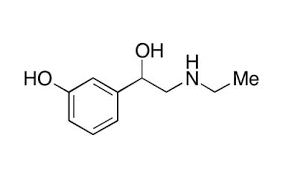
Buy Etilefrine(Effortil) Cas 709-55-7
Etilefrine, sold under the brand name Effortil among others, is a sympathomimetic medication used as an antihypotensive agent to treat orthostatic hypotension.[1] It is usually used by mouth, but is also available as an injectable.[3][4]
Side effects of etilefrine include nausea, tremors, and palpitations, among others.[5] Etilefrine is an agonist of the α- and β-adrenergic receptors.[6] It is a substituted phenethylamine and is related to epinephrine, phenylephrine, and norfenefrine.[2]
Etilefrine was first described and introduced for medical use by 1949.[7][8]
Medical uses
Etilefrine is used to treat orthostatic hypotension and as a nasal decongestant.[5][9] It has also been used off-label to treat priapism.[6][9]
Side effects
Side effects of etilefrine include nausea, tremors, and palpitations, among others.[5]
Pharmacology
Pharmacodynamics
Etilefrine is an agonist of the α1-adrenergic receptor.[5] It is a vasoconstrictor and antihypotensive agent.[5] It has also been described as a β1-adrenergic receptor agonist with some agonistic actions at the α- and β2-adrenergic receptors.[9]
Intravenous infusion of this compound increases cardiac output, stroke volume, venous return, and blood pressure in humans and animals, suggesting stimulation of both α- and β-adrenergic receptors.[10][11][12][13][14] However, in vitro studies indicate that etilefrine has a much higher affinity for β1 (cardiac) than for β2 adrenoreceptors.[15]
Intravenous etilefrine increases the pulse rate, cardiac output, stroke volume, central venous pressure, and mean arterial pressure of healthy individuals. Peripheral vascular resistance falls during the infusion of 1 to 8 mg etilefrine but begins to rise at higher dosage. Marked falls in pulse rate, cardiac output, stroke volume, and peripheral blood flow, accompanied by rises in mean arterial pressure, occur when etilefrine is infused after administration of intravenous propranolol 2.5 mg. These findings indicate that etilefrine has both β1– and α1-adrenergic receptor actions in humans.
Reviews
There are no reviews yet.