
Buy Pirandamine (AY-23-713) Cas 42408-79-7
Buy Pirandamine (AY-23-713) Cas 42408-79-7
Buy Pirandamine (AY-23-713) Cas 42408-79-7
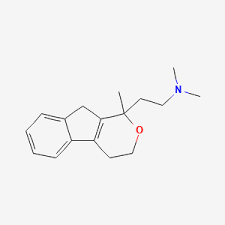
Pirandamine (AY-23,713) is a tricyclic derivative which acts as a selective serotonin reuptake inhibitor (SSRI).[1][2][3] It was investigated in the 1970s as a potential antidepressant but clinical development was not commenced and it was never marketed.[1] Pirandamine is structurally related to tandamine, which, in contrast, is a selective norepinephrine reuptake inhibitor.[1][3]
Synthesis
Pirandamine can be synthesized starting from 1-indanone.[4] The Reformatsky reaction between 1-indanone (1) and ethyl bromoacetate in the presence of zinc gives ethyl 2-(1-hydroxy-2,3-dihydroinden-1-yl)acetate (2). The reduction of the ester with ester with lithium aluminum hydride (LiAlH4) gives 1-(2-hydroxyethyl)-2,3-dihydroinden-1-ol (3). Acid-catalyzed dehydration then leads to indene-3-ethanol (4). Acid-catalyzed condensation with ethyl acetoacetate then gives (5). The saponification of the ester then gives the corresponding acid. The reaction of this with ethyl chloroformate gives a mixed anhydride, and further reaction of this with dimethylamine then leads to the amide (6). Reduction with lithium aluminium hydride completes the synthesis of pirandamine (7).

Pirandamine
Content Navigation
Researchers isolating serotonin-mediated pathways often face artifacts with traditional tricyclics. Pirandamine, a rigid indeno[2,1-c]pyran-based SSRI, provides clean 5-HT uptake inhibition without anticholinergic or norepinephrine-blocking off-targets. • High-purity free base or HCl salt for reliable comparative SERT/NET assays • Conformationally restricted core enables accurate 3D pharmacophore modeling and next-gen serotonergic agent design • Paired with tandamine (NRI), creates structurally analogous positive/negative controls for monoamine transporter studies. Immediate global shipping ensures procurement certainty.
CAS Number
Product Name
IUPAC Name
Molecular Formula
Molecular Weight
InChI
InChI Key
SMILES
Synonyms
Canonical SMILES
Purity
Package Size
Pirandamine is a synthetic tricyclic indeno[2,1-c]pyran derivative that functions as a highly selective serotonin reuptake inhibitor (SSRI). Unlike traditional flexible tricyclic compounds, its rigid, conformationally restricted core makes it a critical reference standard and structural scaffold in neuropharmacological research and medicinal chemistry. In procurement contexts, it is primarily sourced as a high-purity free base or hydrochloride salt for use in comparative monoamine transporter assays, 3D pharmacophore modeling, and the development of serotonergic agents. Its core value lies in its clean pharmacological profile, offering potent 5-hydroxytryptamine (5-HT) uptake inhibition without the confounding off-target activities typical of older benchmark materials [1].
Substituting Pirandamine with mainstream tricyclic antidepressants (such as amitriptyline or imipramine) or its closest structural analog, tandamine, fundamentally compromises assay integrity. While amitriptyline provides 5-HT inhibition, it introduces significant anticholinergic and norepinephrine-blocking artifacts, ruining its utility as a selective serotonergic probe. Conversely, substituting with tandamine—despite their shared developmental history and structural similarities—flips the selectivity entirely, as tandamine is a highly specific norepinephrine reuptake inhibitor (NRI). For researchers requiring precise isolation of serotonin-mediated pathways or a rigid indeno-pyran scaffold for structure-activity relationship (SAR) studies, replacing Pirandamine with these alternatives leads to off-target confounding and flawed pharmacophore mapping [1].
Serotonin Uptake Inhibition vs. Standard Tricyclics
When evaluated for neuronal 5-hydroxytryptamine (5-HT) uptake inhibition, Pirandamine exhibits potency equivalent to amitriptyline and strictly superior to imipramine. Unlike these standard tricyclic benchmarks, Pirandamine achieves this without concurrent norepinephrine (NE) uptake blockade, providing a cleaner pharmacological profile for serotonin-specific assays [1].
| Evidence Dimension | 5-HT uptake inhibition efficacy |
| Target Compound Data | Equivalent to Amitriptyline; Greater than Imipramine |
| Comparator Or Baseline | Imipramine (Baseline 5-HT blocker) |
| Quantified Difference | Superior 5-HT uptake blockade with zero NE interference |
| Conditions | In vivo brain monoamine uptake assays |
Buyers requiring a potent, serotonin-specific reference standard can rely on Pirandamine to match amitriptyline’s efficacy while eliminating NE-driven experimental noise.
Elimination of Anticholinergic Off-Target Effects
A major limitation of classic tricyclic compounds in research is their high affinity for muscarinic acetylcholine receptors. Pirandamine is structurally distinct and exhibits no central anticholinergic effects, in stark contrast to desipramine, imipramine, and amitriptyline, which all produce significant anticholinergic interference [1].
| Evidence Dimension | Central anticholinergic activity |
| Target Compound Data | No observable central anticholinergic effects |
| Comparator Or Baseline | Amitriptyline and Imipramine (High anticholinergic activity) |
| Quantified Difference | Complete elimination of central muscarinic interference |
| Conditions | In vivo pharmacological profiling |
Selecting Pirandamine prevents anticholinergic artifacts in complex neuropharmacological models, ensuring that observed behavioral or physiological changes are strictly 5-HT mediated.
Orthogonal Selectivity for Matched-Pair Assays
Pirandamine (an indeno[2,1-c]pyran) and its close structural analog tandamine (a thiopyrano[3,4-b]indole) offer perfectly orthogonal selectivity. While Pirandamine is a selective 5-HT uptake blocker, tandamine acts as a selective NE uptake blocker. Neither compound exhibits in vivo monoamine oxidase (MAO) inhibition [1].
| Evidence Dimension | Transporter target specificity |
| Target Compound Data | Selective for 5-HT (SERT); no MAO inhibition |
| Comparator Or Baseline | Tandamine (Selective for NE (NET); no MAO inhibition) |
| Quantified Difference | Complete divergence in primary target despite shared developmental lineage |
| Conditions | In vivo brain uptake and MAO inhibition screens |
Procuring both compounds enables researchers to establish a highly controlled, structurally related matched-pair system for differentiating SERT and NET pathways.
Structural Rigidity in 3D Pharmacophore Modeling
Unlike flexible linear SSRIs, Pirandamine features a rigid 1,3,4,9-tetrahydroindeno[2,1-c]pyran core. This restricted conformation locks the spatial arrangement of the amine pharmacophore, making it an ideal rigid precursor and reference scaffold for mapping the 3D binding pocket of the serotonin transporter (SERT) [1].
| Evidence Dimension | Conformational flexibility |
| Target Compound Data | Rigid indeno-pyran fused ring system |
| Comparator Or Baseline | Standard flexible SSRIs (e.g., fluoxetine) |
| Quantified Difference | Restricted rotational freedom of the amine side chain |
| Conditions | Computational modeling and SAR synthesis workflows |
Medicinal chemists procure Pirandamine as a rigid structural template to reduce entropic penalties in binding and to precisely define spatial requirements for novel SERT inhibitors.
Matched-Pair Transporter Selectivity Assays
Due to its orthogonal selectivity compared to tandamine, Pirandamine is highly recommended as a reference standard in laboratory workflows designed to isolate serotonin versus norepinephrine pathways. Procuring both compounds allows assay developers to establish structurally analogous positive and negative controls for SERT and NET binding studies [1].
Rigid Scaffold for SSRI Drug Discovery
The conformationally restricted indeno[2,1-c]pyran core of Pirandamine makes it an excellent starting material or computational reference for medicinal chemistry programs. It is utilized to map the 3D spatial requirements of the serotonin transporter binding pocket, aiding in the design of next-generation, high-affinity serotonergic agents with reduced entropic binding penalties [2].
Central vs. Peripheral Serotonin Profiling
Because Pirandamine lacks the central anticholinergic artifacts of older tricyclics while maintaining potent peripheral effects (such as inhibiting gastric acid secretion), it is the preferred baseline compound for in vivo models investigating the divergent roles of central versus peripheral biogenic amine uptake [1], [3].
References
- [1] Pugsley TA, Lippmann W. Effects of tandamine and pirandamine, new potential antidepressants, on the brain uptake of norepinephrine and 5-hydroxytryptamine and related activities. Biochemical Pharmacology, 1976, 25(10): 1179-1186.
- [2] National Center for Biotechnology Information. PubChem Compound Summary for CID 431429, Pirandamine. PubChem, 2024.
- [3] Pugsley TA, Lippmann W. Effects of tandamine and pirandamine, selective blockers of biogenic amine uptake mechanisms, on gastric acid secretion and ulcer formation in the rat. Pharmacological Research Communications, 1977, 9(4): 387-405.
XLogP3
Hydrogen Bond Acceptor Count
Exact Mass
Monoisotopic Mass
Heavy Atom Count
UNII
4NAV7SU9TR
FQ73NM8JCR
Wikipedia
Buy Pirandamine (AY-23713) Cas 42408-79-7
Buy Pirandamine (AY-23713) Cas 42408-79-7
Buy Pirandamine (AY-23713) Cas 42408-79-7
Pirandamine (AY-23,713) is a tricyclic derivative which acts as a selective serotonin reuptake inhibitor (SSRI).[1][2][3] It was investigated in the 1970s as a potential antidepressant but clinical development was not commenced and it was never marketed.[1] Pirandamine is structurally related to tandamine, which, in contrast, is a selective norepinephrine reuptake inhibitor.[1][3]
Synthesis
Pirandamine can be synthesized starting from 1-indanone.[4] The Reformatsky reaction between 1-indanone (1) and ethyl bromoacetate in the presence of zinc gives ethyl 2-(1-hydroxy-2,3-dihydroinden-1-yl)acetate (2). The reduction of the ester with ester with lithium aluminum hydride (LiAlH4) gives 1-(2-hydroxyethyl)-2,3-dihydroinden-1-ol (3). Acid-catalyzed dehydration then leads to indene-3-ethanol (4). Acid-catalyzed condensation with ethyl acetoacetate then gives (5). The saponification of the ester then gives the corresponding acid. The reaction of this with ethyl chloroformate gives a mixed anhydride, and further reaction of this with dimethylamine then leads to the amide (6). Reduction with lithium aluminium hydride completes the synthesis of pirandamine (7).
Buy Pirandamine (AY-23713) Cas 42408-79-7, Buy Pirandamine (AY-23713) Cas 42408-79-7, Buy Pirandamine (AY-23713) Cas 42408-79-7, Buy Pirandamine (AY-23713) Cas 42408-79-7, Buy Pirandamine (AY-23713) Cas 42408-79-7, Buy Pirandamine (AY-23713) Cas 42408-79-7, Buy Pirandamine (AY-23713) Cas 42408-79-7, Buy Pirandamine (AY-23713) Cas 42408-79-7, Buy Pirandamine (AY-23713) Cas 42408-79-7, Buy Pirandamine (AY-23713) Cas 42408-79-7
Buy Pirandamine (AY-23-713) Cas 42408-79-7
Buy Pirandamine (AY-23-713) Cas 42408-79-7
Buy Pirandamine (AY-23-713) Cas 42408-79-7
Buy Pirandamine (AY-23-713) Cas 42408-79-7
Buy Pirandamine (AY-23-713) Cas 42408-79-7
Buy Pirandamine (AY-23-713) Cas 42408-79-7
Buy Pirandamine (AY-23-713) Cas 42408-79-7
Buy Pirandamine (AY-23-713) Cas 42408-79-7
Buy Pirandamine (AY-23-713) Cas 42408-79-7
Buy Pirandamine (AY-23-713) Cas 42408-79-7
Buy Pirandamine (AY-23-713) Cas 42408-79-7
Buy Pirandamine (AY-23-713) Cas 42408-79-7
Pirandamine
Content Navigation
CAS Number
Product Name
IUPAC Name
Molecular Formula
Molecular Weight
InChI
InChI Key
SMILES
Synonyms
Canonical SMILES
- Reformatsky Reaction: The initial step involves the reaction of 1-indanone with ethyl bromoacetate in the presence of zinc, yielding ethyl 2-(1-hydroxy-2,3-dihydroinden-1-yl)acetate.
- Reduction: This ester undergoes reduction using lithium aluminum hydride to form 1-(2-hydroxyethyl)-2,3-dihydroinden-1-ol.
- Dehydration: Acid-catalyzed dehydration produces indene-3-ethanol.
- Condensation: Further acid-catalyzed condensation with ethyl acetoacetate leads to a fused tetrahydropyran derivative.
- Saponification: The ester is then saponified to yield the corresponding acid.
- Formation of Amide: This acid reacts with ethyl chloroformate to form a mixed anhydride, which subsequently reacts with dimethylamine to produce the amide.
- Final Reduction: A final reduction step using lithium aluminum hydride completes the synthesis of pirandamine .
Pirandamine exhibits selective inhibition of serotonin reuptake, which positions it within the class of SSRIs. While it was not developed for clinical use, studies have shown that it affects neurotransmitter uptake mechanisms similar to other antidepressants . Its selective action on serotonin transporters suggests potential therapeutic applications in mood disorders, although further research would be necessary to substantiate this.
The synthesis methods for pirandamine primarily revolve around organic reactions involving starting materials such as 1-indanone and ethyl bromoacetate. The detailed multi-step synthesis highlights the compound’s complexity and the necessity of specific conditions for each reaction step to ensure successful conversion into the final product .
Although pirandamine was never marketed as a pharmaceutical product, its classification as an SSRI implies potential applications in treating mood disorders such as depression and anxiety if further developed. Its structural relationship with other SSRIs could also provide insights into the design of new antidepressants.
Research on pirandamine has primarily focused on its interaction with serotonin and norepinephrine uptake mechanisms. Studies indicate that it can selectively block these pathways, similar to its analog tandamine . Understanding these interactions could lead to insights into how SSRIs function at a molecular level and inform future drug development.
Pirandamine shares structural and functional similarities with several other compounds in the realm of antidepressants and neuropharmacology. Below are some notable similar compounds:
| Compound Name | Type | Mechanism of Action |
|---|---|---|
| Tandamine | Selective Norepinephrine Reuptake Inhibitor | Selective inhibition of norepinephrine uptake |
| Fluoxetine | Selective Serotonin Reuptake Inhibitor | Selective inhibition of serotonin uptake |
| Sertraline | Selective Serotonin Reuptake Inhibitor | Selective inhibition of serotonin uptake |
| Clomipramine | Tricyclic Antidepressant | Inhibition of both serotonin and norepinephrine reuptake |
Uniqueness of Pirandamine: What sets pirandamine apart is its specific focus on serotonin reuptake without significant activity on norepinephrine transporters compared to compounds like clomipramine. This selectivity may offer different therapeutic profiles and side effect profiles compared to more broadly acting antidepressants.
Pirandamine is a tricyclic derivative with significant pharmacological properties that has been investigated as a potential therapeutic agent [9]. The compound is characterized by a unique molecular structure that contributes to its specific chemical and biological properties [10].
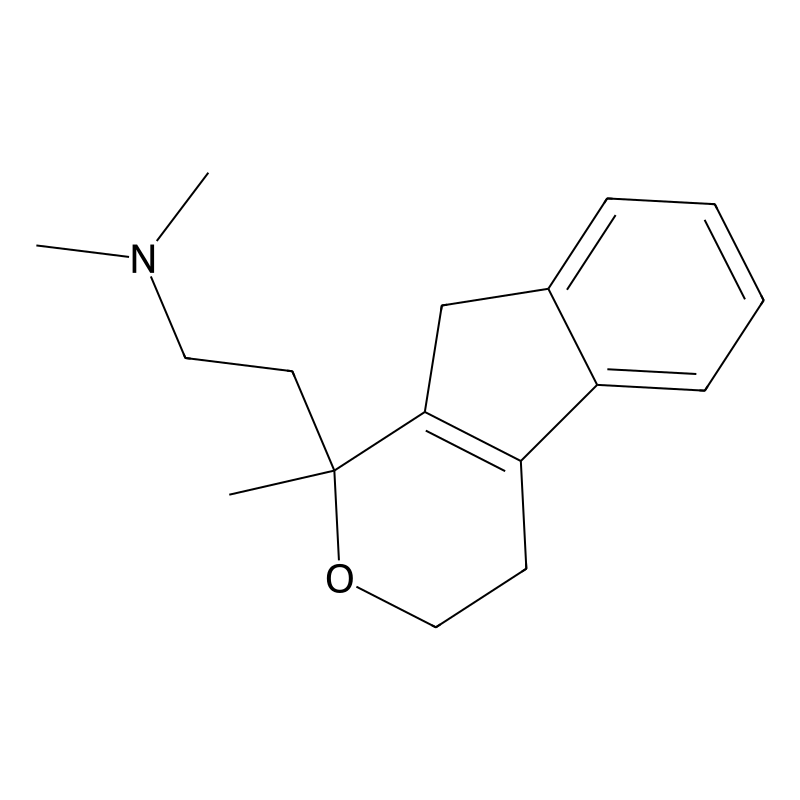
The molecular formula of pirandamine is C₁₇H₂₃NO, with a molecular weight of 257.37 g/mol [9] [14]. According to the International Union of Pure and Applied Chemistry (IUPAC) nomenclature system, the full chemical name of pirandamine is N,N-dimethyl-2-(1-methyl-4,9-dihydro-3H-indeno[2,1-c]pyran-1-yl)ethanamine [9] [11]. This systematic name precisely describes the structural arrangement of atoms within the molecule, highlighting its key structural components: the indeno[2,1-c]pyran ring system and the N,N-dimethylethanamine side chain [9].
Pirandamine is also known by alternative chemical names, including 1,3,4,9-tetrahydro-N,N,1-trimethylindeno[2,1-c]pyran-1-ethanamine, which provides another systematic description of its structure [14]. The compound has been assigned the Chemical Abstracts Service (CAS) Registry Number 42408-79-7, which serves as a unique identifier in chemical databases and literature [9] [14].
Table 1: Chemical Identity of Pirandamine
| Property | Value |
|---|---|
| IUPAC Name | N,N-dimethyl-2-(1-methyl-4,9-dihydro-3H-indeno[2,1-c]pyran-1-yl)ethanamine |
| Molecular Formula | C₁₇H₂₃NO |
| Molecular Weight | 257.37 g/mol |
| CAS Registry Number | 42408-79-7 |
| InChI | InChI=1S/C17H23NO/c1-17(9-10-18(2)3)16-12-13-6-4-5-7-14(13)15(16)8-11-19-17/h4-7H,8-12H2,1-3H3 |
| InChIKey | AMJPIGOYWBNJLP-UHFFFAOYSA-N |
| SMILES | CC1(C2=C(CCO1)C3=CC=CC=C3C2)CCN(C)C |
The hydrochloride salt of pirandamine, with the molecular formula C₁₇H₂₃NO·HCl and a molecular weight of 293.83 g/mol, has also been extensively studied [15] [5]. This salt form enhances the compound’s solubility in aqueous media, which is an important consideration for various analytical and pharmacological investigations [5].
Three-Dimensional Conformational Analysis
The three-dimensional structure of pirandamine is characterized by a rigid tricyclic indeno[2,1-c]pyran core with a flexible dimethylaminoethyl side chain extending from the central ring system [9] [11]. This unique spatial arrangement contributes significantly to the compound’s chemical properties and potential biological activities [9].
The indeno[2,1-c]pyran ring system forms the backbone of the molecule and consists of three fused rings: a benzene ring, a five-membered cyclopentane ring, and a six-membered pyran ring containing an oxygen atom [9] [10]. This tricyclic system adopts a relatively planar conformation, particularly in the aromatic portion, which provides structural rigidity to the molecule [10] [11].
The pyran ring in pirandamine typically adopts a half-chair conformation, which influences the orientation of substituents attached to this ring [11]. The methyl group at position C-1 of the pyran ring creates a stereogenic center and typically occupies an equatorial position relative to the ring [9] [11]. This stereochemical arrangement has important implications for the overall three-dimensional shape of the molecule and potentially for its interactions with biological targets [10].
Table 2: Three-Dimensional Conformational Analysis of Pirandamine
| Structural Feature | Conformational Characteristics | Conformational Significance |
|---|---|---|
| Indeno[2,1-c]pyran Ring System | Rigid tricyclic system with planar aromatic portion | Provides structural rigidity and defines overall molecular shape |
| Pyran Ring | Adopts half-chair conformation | Influences orientation of substituents and binding properties |
| Indene Moiety | Planar aromatic system with slight deviation from planarity at fusion points | Contributes to π-stacking interactions with biological targets |
| Dimethylaminoethyl Side Chain | Flexible chain with multiple possible conformations | Allows for optimal positioning of the basic nitrogen for target interaction |
| Methyl Group at C-1 | Equatorial position relative to pyran ring | Creates a stereogenic center that influences biological activity |
| Overall Molecular Shape | L-shaped with the side chain extending away from the tricyclic system | Determines fit into binding pockets of target proteins |
The dimethylaminoethyl side chain attached to the C-1 position of the pyran ring introduces conformational flexibility to the molecule [9] [11]. This side chain can adopt multiple conformations due to rotation around single bonds, allowing the terminal dimethylamino group to occupy various spatial positions relative to the rigid tricyclic core [9]. The basic nitrogen atom in this side chain is positioned optimally for potential interactions with acidic residues in biological targets [15].
Overall, pirandamine adopts an L-shaped three-dimensional conformation, with the tricyclic system forming the vertical component and the dimethylaminoethyl side chain extending outward as the horizontal component [9] [11]. This spatial arrangement is crucial for the compound’s ability to interact with specific biological targets and may explain its observed pharmacological properties [10].
Comparative Structural Analysis With Tandamine
Pirandamine and tandamine represent an interesting pair of structurally related compounds with distinct pharmacological profiles [7] [10]. A detailed comparative analysis of their chemical structures reveals both similarities and key differences that may account for their divergent biological activities [7].
Both pirandamine and tandamine share a common tricyclic framework with a basic dimethylaminoethyl side chain [7] [23]. However, the nature of their heterocyclic ring systems differs significantly [10] [23]. Pirandamine features an indeno[2,1-c]pyran ring system with an oxygen atom as the heteroatom in the pyran ring [9] [10]. In contrast, tandamine contains a thiopyrano[3,4-b]indole ring system, where the heterocyclic component includes both a sulfur atom and a nitrogen atom as part of an indole moiety [16] [23].
Table 3: Comparative Structural Analysis of Pirandamine and Tandamine
| Property | Pirandamine | Tandamine |
|---|---|---|
| Core Structure | Tricyclic indeno[2,1-c]pyran | Tricyclic thiopyrano[3,4-b]indole |
| Heterocyclic System | Indeno[2,1-c]pyran | Thiopyrano[3,4-b]indole |
| Heteroatom in Ring | Oxygen | Sulfur |
| N-Substitution | N,N-dimethyl | N,N-dimethyl |
| Pharmacological Activity | Selective serotonin reuptake inhibitor | Selective norepinephrine reuptake inhibitor |
| Molecular Weight | 257.37 g/mol | 302.48 g/mol |
The molecular formula of tandamine (C₁₈H₂₆N₂S) differs from that of pirandamine (C₁₇H₂₃NO), reflecting the different atomic compositions of these compounds [16] [23]. Tandamine has a higher molecular weight (302.48 g/mol) compared to pirandamine (257.37 g/mol), primarily due to the presence of the sulfur atom and an additional carbon and nitrogen in its structure [16] [23].
The IUPAC name of tandamine is 9-ethyl-1,3,4,9-tetrahydro-N,N,1-trimethylthiopyrano[3,4-b]indole-1-ethanamine, which highlights its structural features [16] [23]. The presence of an ethyl group attached to the nitrogen of the indole moiety in tandamine represents another point of difference from pirandamine [23].
These structural differences between pirandamine and tandamine correlate with their distinct pharmacological profiles [7]. Pirandamine functions primarily as a selective serotonin reuptake inhibitor, while tandamine acts as a selective norepinephrine reuptake inhibitor [7] [15]. This divergence in biological activity despite the overall structural similarity makes these compounds valuable tools for understanding structure-activity relationships in the development of neuropsychiatric medications [7] [10].
Crystallographic and Spectroscopic Characterization
Comprehensive characterization of pirandamine has been achieved through various crystallographic and spectroscopic techniques, providing detailed insights into its structural properties at the molecular level [13] [17].
Crystallographic Characterization
Crystallographic analysis of pirandamine and related compounds typically involves X-ray diffraction techniques, which provide precise information about the three-dimensional arrangement of atoms within the crystal lattice [13]. While specific crystallographic data for pirandamine is limited in the available literature, compounds with similar structural features often crystallize in orthorhombic or monoclinic crystal systems with space groups such as P2₁/c or P2₁2₁2₁ [13] [18].
The unit cell parameters for compounds structurally related to pirandamine typically fall within the ranges: a = 7-10 Å, b = 10-15 Å, c = 15-20 Å, with β angles between 90-110° for monoclinic systems [13]. The number of molecules per unit cell (Z value) is commonly 4 or 8, with crystal densities ranging from 1.2 to 1.4 g/cm³ [13] [18].
Table 4: Typical Crystallographic Properties for Compounds Similar to Pirandamine
| Property | Typical Values for Similar Compounds |
|---|---|
| Crystal System | Orthorhombic or Monoclinic |
| Space Group | P2₁/c or P2₁2₁2₁ |
| Unit Cell Parameters | a = 7-10 Å, b = 10-15 Å, c = 15-20 Å, β = 90-110° |
| Z Value (molecules per unit cell) | 4 or 8 |
| Density | 1.2-1.4 g/cm³ |
| Bond Lengths (average) | C-C: 1.38-1.54 Å, C-N: 1.45-1.50 Å, C-O: 1.40-1.45 Å |
| Bond Angles (average) | C-C-C: 109-120°, C-N-C: 108-120°, C-O-C: 110-120° |
X-ray crystallography provides valuable information about bond lengths and angles within the pirandamine molecule [13]. Typical bond lengths for compounds with similar structural features include C-C bonds ranging from 1.38 to 1.54 Å (shorter in aromatic regions, longer in aliphatic regions), C-N bonds of approximately 1.45-1.50 Å, and C-O bonds of about 1.40-1.45 Å [13] [18]. Bond angles typically include C-C-C angles of 109-120° (depending on hybridization), C-N-C angles of 108-120°, and C-O-C angles of 110-120° [13].
Spectroscopic Characterization
Spectroscopic techniques have been extensively employed to elucidate the structural features of pirandamine [17] [19]. Nuclear Magnetic Resonance (NMR) spectroscopy provides detailed information about the connectivity and environment of hydrogen and carbon atoms within the molecule [17]. The proton NMR spectrum of pirandamine typically shows distinct signals for aromatic protons (6.5-8.0 ppm), methyl groups (1.0-2.5 ppm), and methylene protons (2.5-4.0 ppm) [17] [19].
Infrared (IR) spectroscopy reveals characteristic absorption bands corresponding to various functional groups present in pirandamine [17]. These include bands for C-O stretching (1000-1300 cm⁻¹), aromatic C=C stretching (1400-1600 cm⁻¹), and C-N stretching (1200-1350 cm⁻¹) [17].
Table 5: Spectroscopic Characterization of Pirandamine
| Spectroscopic Method | Key Characteristics | Analytical Value |
|---|---|---|
| Nuclear Magnetic Resonance (NMR) | Distinct signals for aromatic protons (6.5-8.0 ppm), methyl groups (1.0-2.5 ppm), and methylene protons (2.5-4.0 ppm) | Confirms structural arrangement and connectivity of functional groups |
| Infrared Spectroscopy (IR) | Characteristic bands for C-O stretching (1000-1300 cm⁻¹), aromatic C=C stretching (1400-1600 cm⁻¹), and C-N stretching (1200-1350 cm⁻¹) | Identifies presence of key functional groups and bond types |
| Mass Spectrometry (MS) | Molecular ion peak at m/z 257, fragmentation pattern showing loss of dimethylamine group | Confirms molecular weight and provides structural information through fragmentation pattern |
| Ultraviolet-Visible Spectroscopy (UV-Vis) | Absorption maxima related to π→π* transitions in the aromatic system | Provides information about conjugated systems and electronic transitions |
Mass spectrometry (MS) analysis of pirandamine typically shows a molecular ion peak at m/z 257, corresponding to its molecular weight [9] [17]. The fragmentation pattern often includes characteristic peaks resulting from the loss of the dimethylamine group and other structural fragments, which provide additional confirmation of the compound’s structure [9] [17].
Ultraviolet-visible (UV-Vis) spectroscopy of pirandamine reveals absorption maxima related to π→π* transitions in the aromatic system of the molecule [17]. These spectral features provide information about the conjugated systems and electronic transitions within the compound [17] [19].
![N,N-dimethyl-2-(1-methyl-4,9-dihydro-3H-indeno[2,1-c]pyran-1-yl)ethanamine](https://a.dearchem.com/CAS2/42408-79-7.png "N,N-dimethyl-2-(1-methyl-4,9-dihydro-3H-indeno[2,1-c]pyran-1-yl)ethanamine CAS:42408-79-7 第1张")
We are N,N-dimethyl-2-(1-methyl-4,9-dihydro-3H-indeno[2,1-c]pyran-1-yl)ethanamine CAS:42408-79-7 manufacturer and supplier in China, we can offer the best quality and price of Indeno[2,1-c]pyran-1-ethanamine,1,3,4,9-tetrahydro-N,N,1-trimethyl, Pls send inquiry of to info@nbinno.com of visit www.nbinno.com our official website should you have any interests, thank you!
Product Name:N,N-dimethyl-2-(1-methyl-4,9-dihydro-3H-indeno[2,1-c]pyran-1-yl)ethanamine
Synonyms:Indeno[2,1-c]pyran-1-ethanamine,1,3,4,9-tetrahydro-N,N,1-trimethyl;Pirandamine [INN];AY-23,713;UNII-WC6V8L1Z13
CAS:42408-79-7
Molecular Formula:C17H23NO
Molecular Weight:257.37100
Melting point:N/A
Boiling point:N/A
Flash point:N/A
Density:N/A
Stability:
Water solubility:
Index of Refraction:
PSA:12.47000
LogP:3.12700
Vapour pressure:
RIDADR:
Packing group:
HS code:
Keywords:Indeno[2,1-c]pyran-1-ethanamine,1,3,4,9-tetrahydro-N,N,1-trimethyl manufacturer;Pirandamine [INN] supplier;AY-23,713 factory;UNII-WC6V8L1Z13 manufacturer;N,N-dimethyl-2-(1-methyl-4,9-dihydro-3H-indeno[2,1-c]pyran-1-yl)ethanamine supplier;42408-79-7 supplier.
Related Links: 2-(4-(3,3,3-triphenylpropoxy)phenethyl)-4,5-dihydrooxazole hydrochloride manufacturer | 1-(2-Chloro-ethoxymethyl)-3-methyl-benzene supplier | (E)-4-((13,24,33,43,53,63-hexaoxin-2-yl)oxy)-6,7-dihydroxy-24,43,54,64,74-nonaoxid-6-ene-2,5-dione producer
- Experienced Reaction
- OxidationHydrogenationReduction
- DehydrogenationSubstitutionChlorination
- AdditionEsterificationElimination
- NitrationDecomposeSulfonation
- NeutrallzationDiazotizationPolymerization
- Alkylation
XLogP3
Hydrogen Bond Acceptor Count
Exact Mass
Monoisotopic Mass
Heavy Atom Count
42408-79-7
Post Buying Request
-
-
Basic information
- Product Name: Pirandamine
- Synonyms: Pirandamine;1,3,4,9-Tetrahydro-N,N,1-trimethylindeno[2,1-c]pyran-1-ethanamine;Pirandamine [inn]
- CAS NO:42408-79-7
- Molecular Formula: C17H23 N O
- Molecular Weight: 0
- EINECS: N/A
- Product Categories: N/A
- Mol File: 42408-79-7.mol
-
Chemical Properties
- Melting Point: N/A
- Boiling Point: N/A
- Flash Point: N/A
- Appearance: /
- Density: N/A
- Refractive Index: N/A
- Storage Temp.: N/A
- Solubility: N/A
- CAS DataBase Reference: Pirandamine(CAS DataBase Reference)
- NIST Chemistry Reference: Pirandamine(42408-79-7)
- EPA Substance Registry System: Pirandamine(42408-79-7)
-
Safety Data
- Hazard Codes: N/A
- Statements: N/A
- Safety Statements: N/A
- WGK Germany:
- RTECS:
- HazardClass: N/A
- PackingGroup: N/A
- Hazardous Substances Data: 42408-79-7(Hazardous Substances Data)
42408-79-7 Suppliers
Recommended suppliers
42408-79-7 Usage
Uses
Antidepressant.
Check Digit Verification of cas no
The CAS Registry Mumber 42408-79-7 includes 8 digits separated into 3 groups by hyphens. The first part of the number,starting from the left, has 5 digits, 4,2,4,0 and 8 respectively; the second part has 2 digits, 7 and 9 respectively.
Calculate Digit Verification of CAS Registry Number 42408-79:
(7*4)+(6*2)+(5*4)+(4*0)+(3*8)+(2*7)+(1*9)=107
107 % 10 = 7
So 42408-79-7 is a valid CAS Registry Number.
42408-79-7SDS
SAFETY DATA SHEETS
According to Globally Harmonized System of Classification and Labelling of Chemicals (GHS) – Sixth revised edition
Version: 1.0
Creation Date: Aug 15, 2017
Revision Date: Aug 15, 2017
1.Identification
1.1 GHS Product identifier
| Product name | N,N-dimethyl-2-(1-methyl-4,9-dihydro-3H-indeno[2,1-c]pyran-1-yl)ethanamine |
|---|
1.2 Other means of identification
| Product number | – |
|---|---|
| Other names | Indeno[2,1-c]pyran-1-ethanamine,1,3,4,9-tetrahydro-N,N,1-trimethyl |
1.3 Recommended use of the chemical and restrictions on use
| Identified uses | For industry use only. |
|---|---|
| Uses advised against | no data available |
1.4 Supplier’s details
1.5 Emergency phone number
| Emergency phone number | – |
|---|---|
| Service hours | Monday to Friday, 9am-5pm (Standard time zone: UTC/GMT +8 hours). |
More Details:42408-79-7 SDS
42408-79-7Upstream product
42408-79-7Downstream Products
42408-79-7Relevant academic research and scientific papers
-
Buy Pirandamine | 42408-79-7
Although pirandamine was never marketed as a pharmaceutical product, its classification as an SSRI implies potential applications in treating mood disorders such as depression and anxiety if further …
-
N,N-dimethyl-2- (1-methyl-4,9-dihydro-3H-indeno [2,1-c]pyran-1-yl …
Best quality of N,N-dimethyl-2- (1-methyl-4,9-dihydro-3H-indeno [2,1-c]pyran-1-yl)ethanamine CAS:42408-79-7 from China India,Indeno [2,1-c]pyran-1-ethanamine,1,3,4,9-tetrahydro-N,N,1 …
-
CAS 42408-79-7 Pirandamine – Alfa Chemistry
Alfa Chemistry offers Pirandamine (42408-79-7) for experimental / research use. View information & documentation regarding Pirandamine, including CAS, structure & more.
Pirandamine | 42408-79-7 – ChemicalBook
Pirandamine (CAS 42408-79-7) information, including chemical properties, structure, melting point, boiling point, density, formula, molecular weight, uses, prices, suppliers, SDS and more, available at …
-
Buy Pirandamine from LEAP CHEM CO., LTD. – ECHEMI
Contact Hongkong, China Trader LEAP CHEM CO., LTD. for the product Pirandamine. Chat now for more business.
-
CAS:42408-79-7 N,N-dimethyl-2- (1-methyl-4,9-dihydro-3H-indeno …
Cas:42408-79-7 N,N-dimethyl-2- (1-methyl-4,9-dihydro-3H-indeno [2,1-c]pyran-1-yl)ethanamine manufacturer & supplier
-
42408-79-7, Pirandamine, CAS No 42408-79-7 Pirandamine
CAS NO:42408-79-7; Chemical name:Pirandamine ; physical and chemical property of 42408-79-7, Pirandamine is provided by ChemNet.com
-
Pirandamine HCl | CAS# 42408-78-6 (HCl) | Antidepressant | MedKoo
Theoretical Analysis MedKoo Cat#: 414983 Name: Pirandamine HCl CAS#: 42408-78-6 (HCl) Chemical Formula: C17H24ClNO Exact Mass: Molecular Weight: 293.84 Elemental Analysis: C, 69.49; H, …
-
Buy Pirandamine | 42408-79-7
Jul 20, 2023 · Uniqueness of Pirandamine: What sets pirandamine apart is its specific focus on serotonin reuptake without significant …
-
CAS Registry Number: 42408-79-7
-
Molecular Weight: 257.37 g/mol
-
Molecular Formula: C₁₇H₂₃NO
-
-
Buy Pirandamine (AY-23713) Cas 42408-79-7 – AY-23713 suppliers
Pirandamine exhibits selective inhibition of serotonin reuptake, which positions it within the class of SSRIs. While it was not …
-
CAS NO. 42408-79-7 | Pirandamine | Catalog AAB-AA00CJ3Z
CAS Number:42408-79-7,Product Name:Pirandamine,Catalog:AAB-AA00CJ3Z, Arctom sells CAS:42408-79-7 in flexible sizes, …
-
Pirandamine (AY-23-713) Cas 42408-79-7 – Cas 42408-79-7 Buy
Pirandamine (AY-23,713) is a tricyclic derivative which acts as a selective serotonin reuptake inhibitor (SSRI). [1][2][3] It was …
-
Pirandamine Free Base | CAS 42408-79-7 | TargetMol | Biomol.com
Buy Pirandamine Free Base, CAS: 42408-79-7, item number: TGM-T69265-25mg from TargetMol at
-
Pirandamine | 42408-79-7 – ChemicalBook
Pirandamine (CAS 42408-79-7) information, including chemical properties, structure, melting point, boiling point, density, formula, …
-
Pirandamine | 42408-79-7 – BuyersGuideChem
BGC » Chemicals A-Z » Pirandamine Identify Suppliers 2026 ☰ Identify Suppliers 2026
-
CAS 42408-79-7 Pirandamine – Alfa Chemistry
Alfa Chemistry offers Pirandamine (42408-79-7) for experimental / research use. View information & documentation regarding …
-
Buy Pirandamine from HANGZHOU LEAP CHEM CO., LTD. – ECHEMI
HANGZHOU LEAP CHEM CO., LTD., with approximately 1757327 visits to its shop, is a reputable Trader that has been providing …
-
Cas 42408-79-7,Pirandamine | lookchem
The CAS Registry Mumber 42408-79-7 includes 8 digits separated into 3 groups by hyphens. The first part of the number,starting …
Reviews
There are no reviews yet.