
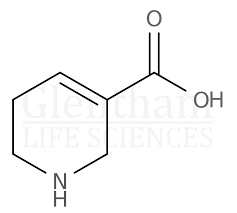
Buy Guvacine (tetrahydropyridine) Cas 498-96-4
Buy Guvacine (tetrahydropyridine) Cas 498-96-4
Guvacine is a tetrahydropyridine alkaloid found in areca nuts.[1] It is the N–demethylated derivative of arecaidine and the product of ester hydrolysis of guvacoline, both of which are also found in areca nuts as well. The compound is a potent and selective GABA reuptake inhibitor via GABA transporter 1 (GAT-1) inhibition.[2][3][4] It shows poor blood–brain barrier penetration.[5] Lime hydrolyzes guvacoline to guvacine.[6]
See also
| Targets |
human GAT-1 (IC50 = 14 μM); rat GAT-1 (IC50 = 39 μM); rat GAT-2 (IC50 = 58 μM); human GAT-3 (IC50 = 119 μM); rat GAT-3 (IC50 = 378 μM)
|
|---|---|
| ln Vitro |
Guvacine HCl has IC50s of 14 μM (human GAT-1), 39 μM (rat GAT-1), and 58 μM (rat GAT-2); 119 μM (human GAT-3); 378 μM (rat GAT-3) and 1870 μM (human BGT-3). It is a strong inhibitor of GABA transporters with moderate selectivity for cloned GABA transporters. Guvacine’s affinity (IC50 > 1 mM) for hBGT-1 is low [1]. Guvacine hydrochloride is a strong inhibitor of GABA uptake, although it has little or no effect as a GABA receptor agonist and does not prevent sodium-dependent GABA binding [2]. Guvacine inhibits the absorption of GABA and β-alanine, with IC50s in the cat spinal cord of 23 ± 2 μM and 66 ± 11 μM, respectively, and in the rat cerebral cortex of 8 ± 1 μM and 123 ± 28 μM [3].
|
| ln Vivo |
Arecaidine and Guvacine, constituents of the nut of Areca catechu, inhibited the uptake of GABA and beta-alanine, but not that of glycine, by slices of cat spinal cord. In cats anesthetised with pentobarbitone, electrophoretic arecaidine enhanced the inhibitory actions of GABA and beta-alanine, but not those of glycine or taurine, on the firing of spinal neurones. Similarly, electrophoretic guvacine enhanced the inhibition of spinal neurones by GABA but not that by glycine. The uptake of GABA by slices of cat cerebellum was inhibited by arecaidine, and the effect of electrophoretic GABA on the firing of cerebellar Purkinje cells was enhanced by electrophoretic arecaidine. When administered intravenously arecaidine failed to affect synaptic inhibitions considered to be mediated by GABA. Intravenous arecaidine had no effect on either spinal prolonged (presynaptic) inhibition (20mg/kg), dorsal root potentials (20mg/kg) or basket cell inhibition of Purkinje cells (250 mg/kg), although topical arecaidine (6.6-10 x 10(-3) M) blocked this latter inhibition. Large doses of arecaidine (1 g/kg subcutaneous) marginally reduced the lethal effects of bicuculline in mice but appeared to have little or no anticonvulsant activity [3]. Gamma-aminobutyric acid A receptor (GABA(A)R)-mediated postsynaptic currents (IPSCs) were recorded from dopaminergic neurons of the ventral tegmental area of young rats in acute brain slices and from mechanically dissociated neurons. Low concentrations (0.1-0.3 microm) of muscimol, a selective GABA(A)R agonist, increased the amplitude, and reduced the paired pulse ratio of evoked IPSCs. Moreover, muscimol increased the frequency but not the amplitude of spontaneous IPSCs (sIPSCs). These data point to a presynaptic locus of muscimol action. It is interesting that 1 microm muscimol caused an inhibition of sIPSCs, which was reversed to potentiation by the GABA(B) receptor antagonist CGP52432. Isoguvacine, a selective GABA(A)R agonist that belongs to a different class, mimicked the effects of muscimol on sIPSCs: it increased them at low (<or= 0.5=”” microm),=”” and=”” decreased=”” them=”” at=”” a=”” higher=”” concentration=”” (1=”” microm).=”” hence,=”” the=”” activation=”” of=”” presynaptic=”” gaba(a)rs=”” facilitates=”” gaba=”” release,=”” which=”” is=”” limited=”” by=”” gaba(b)rs.=”” furthermore,=”” facilitation=”” sipscs=”” muscimol=”” was=”” eliminated=”” in=”” medium=”” containing=”” tetrodotoxin=”” or=”” cadmium.=”” it=”” noteworthy=”” that=”” sipsc=”” frequency=”” greatly=”” increased=”” 4,5,6,7-tetrahydroisoxazolo[5,4-c]pyridin-3-ol(gaboxadol,=”” thip),=”” an=”” agonist=”” with=”” preferential=”” effects=”” on=”” extrasynaptic=”” alpha4betadelta=”” subunits,=”” <strong=””>Guvacine, a GABA transport blocker, which increases ambient GABA levels. In addition, sIPSC frequency was attenuated by furosemide, a selective antagonist of alpha6 subunits. Thus, the presynaptic GABA(A)Rs may be situated at extrasynaptic sites and may contain alpha4/6betadelta subunits. Given the marked sensitivity of extrasynaptic GABA(A)Rs to ambient GABA, alcohols and anaesthetics, these receptors may present a critical site for regulating synaptic function in the developing brain in both physiological and pathological situations [4].</or=> |
| Animal Protocol |
Most of the chemicals including d(–)-2-amino-5-phospho-pentanoate (AP5), 6,7-dinitroquinoxaline-2,3-dione (DNQX), bicuculline (BIC), cadmium chloride, isoguvacine, furosemide, 4,5,6,7-tetrahydroisoxazolo [5,4-c]pyridine-3-ol (gaboxadol, or THIP), Guvacine hydrochloride, Tyr-D-Ala-Gly-N-Me-Phe-Gly-ol enkephalin (DAMGO) and tetrodotoxin (TTX), Muscimol and CGP52432 were obtained commercially. The solutions, prepared before the experiment, were applied to a dissociated neuron with a Y-tube. This exchanged the external solution surrounding the neurons within 40 ms (Zhou et al. 2006). In experiments on brain slices, chemicals were added in known concentrations to the superfusate. The fact that 10 μm bicuculline blocked most IPSCs (in slices) within 90 s is an indication of the effective bath exchange time. [4]
|
| References |
|
| Additional Infomation |
Guvacin is an α,β-unsaturated monocarboxylic acid formed by the hydrogenation of nicotinic acid at positions 1-2 and 5-6 of the pyridine ring. It is a plant metabolite and a GABA reuptake inhibitor. It is a β-amino acid, tetrahydropyridine, α,β-unsaturated monocarboxylic acid, pyridine alkaloid, and secondary amino compound. Guvacin is a pyridine alkaloid found in areca nut (also known as betel leaf). It is an experimental drug and currently has no approved indications. Experimental studies are ongoing to determine all physiological effects and mechanisms of action of guvacin. It has been determined that guvacin is a specific GABA reuptake inhibitor with no significant affinity for GABA receptors. Areca nut has been reported to contain guvacin, and relevant data exist. Drug Indications Guvacin currently has no approved indications. Mechanism of Action Experimental studies are ongoing to determine the exact mechanism of action of guvacin. Guvacin is known to selectively bind to presynaptic GABA reuptake transporters, preventing GABA reuptake, but has no affinity for postsynaptic GABA receptors. Pharmacodynamics Application of the GABA transporter blocker guvacin (20 μm) significantly and reversibly increased the frequency of sIPSCs recorded in brain slices (Figures 7A and C) without inducing significant postsynaptic currents (5 ± 1 pA). Guvacine (20 μm) significantly shifted the cumulative probability map of the interval between consecutive spontaneous inhibitory postsynaptic currents (sIPSC) events to the left (KS test, P < 0.001; Fig. 7B top panel) and increased the sIPSC frequency by 72 ± 14% (n = 7, P = 0.001; Fig. 7B top panel inset), but did not change the amplitude of sIPSC (KS test, P > 0.5; Fig. 7B bottom panel; 0 ± 3%, n = 7, P = 0.46; Fig. 7B bottom panel inset). These results suggest that in the developing brain, elevated levels of environmental GABA can enhance GABAergic sIPSCs through presynaptic mechanisms. [4] |
| Molecular Formula |
C6H9NO2
|
|---|---|
| Molecular Weight |
127.14116
|
| Exact Mass |
127.063
|
| Elemental Analysis |
C, 56.68; H, 7.14; N, 11.02; O, 25.17
|
| CAS # |
498-96-4
|
| Related CAS # |
Guvacine hydrochloride;6027-91-4;Guvacine hydrobromide;6027-92-5
|
| PubChem CID |
3532
|
| Appearance |
Typically exists as solid at room temperature
|
| Density |
1.2±0.1 g/cm3
|
| Boiling Point |
280.8±35.0 °C at 760 mmHg
|
| Melting Point |
306 – 309 °C(lit.)
|
| Flash Point |
123.6±25.9 °C
|
| Vapour Pressure |
0.0±1.2 mmHg at 25°C
|
| Index of Refraction |
1.518
|
| LogP |
0.72
|
| Hydrogen Bond Donor Count |
2
|
| Hydrogen Bond Acceptor Count |
3
|
| Rotatable Bond Count |
1
|
| Heavy Atom Count |
9
|
| Complexity |
151
|
| Defined Atom Stereocenter Count |
0
|
| SMILES |
C1C=C(CNC1)C(=O)O
|
| InChi Key |
QTDZOWFRBNTPQR-UHFFFAOYSA-N
|
| InChi Code |
InChI=1S/C6H9NO2/c8-6(9)5-2-1-3-7-4-5/h2,7H,1,3-4H2,(H,8,9)
|
| Chemical Name |
1,2,3,6-tetrahydropyridine-5-carboxylic acid
|
| Synonyms |
Guvacine; 498-96-4; 1,2,5,6-tetrahydropyridine-3-carboxylic acid; 1,2,5,6-Tetrahydro-3-pyridinecarboxylic acid; 1,2,5,6-Tetrahydronicotinic acid; CHEBI:5576; GUVACINE [MI]; 41538P325K;
|
| HS Tariff Code |
2934.99.9001
|
| Storage |
Powder -20°C 3 years 4°C 2 years In solvent -80°C 6 months -20°C 1 month |
| Shipping Condition |
Room temperature (This product is stable at ambient temperature for a few days during ordinary shipping and time spent in Customs)
|
| Solubility (In Vitro) |
May dissolve in DMSO (in most cases), if not, try other solvents such as H2O, Ethanol, or DMF with a minute amount of products to avoid loss of samples
|
|---|---|
| Solubility (In Vivo) |
Note: Listed below are some common formulations that may be used to formulate products with low water solubility (e.g. < 1 mg/mL), you may test these formulations using a minute amount of products to avoid loss of samples. Injection Formulations
(e.g. IP/IV/IM/SC) Injection Formulation 1: DMSO : Tween 80: Saline = 10 : 5 : 85 (i.e. 100 μL DMSO stock solution → 50 μL Tween 80 → 850 μL Saline) View MoreInjection Formulation 4: DMSO : 20% SBE-β-CD in saline = 10 : 90 [i.e. 100 μL DMSO → 900 μL (20% SBE-β-CD in saline)] Oral Formulations
Oral Formulation 1: Suspend in 0.5% CMC Na (carboxymethylcellulose sodium) View MoreOral Formulation 3: Dissolved in PEG400
Note: Please be aware that the above formulations are for reference only. InvivoChem strongly recommends customers to read literature methods/protocols carefully before determining which formulation you should use for in vivo studies, as different compounds have different solubility properties and have to be formulated differently. (Please use freshly prepared in vivo formulations for optimal results.) |
| Preparing Stock Solutions | 1 mg | 5 mg | 10 mg | |
| 1 mM | 7.8653 mL | 39.3267 mL | 78.6535 mL | |
| 5 mM | 1.5731 mL | 7.8653 mL | 15.7307 mL | |
| 10 mM | 0.7865 mL | 3.9327 mL | 7.8653 mL |
*Note: Please select an appropriate solvent for the preparation of stock solution based on your experiment needs. For most products, DMSO can be used for preparing stock solutions (e.g. 5 mM, 10 mM, or 20 mM concentration); some products with high aqueous solubility may be dissolved in water directly. Solubility information is available at the above Solubility Data section. Once the stock solution is prepared, aliquot it to routine usage volumes and store at -20°C or -80°C. Avoid repeated freeze and thaw cycles.
Molarity Calculator allows you to calculate the mass, volume, and/or concentration required for a solution, as detailed below:
- Calculate the Mass of a compound required to prepare a solution of known volume and concentration
- Calculate the Volume of solution required to dissolve a compound of known mass to a desired concentration
- Calculate the Concentration of a solution resulting from a known mass of compound in a specific volume
+
+
+
-
Guvacine
GABA transporterGAT-1GAT-2Neuroscientists investigating GABAergic transmission require pharmacological tools with well-characterized transporter selectivity and no off-target receptor activity. Guvacine-a naturally occurring tetrahydropyridine alkaloid from Areca catechu-is a specific, competitive GABA reuptake inhibitor meeting these exact criteria.
• Distinct GAT isoform inhibition: IC50 = 39 μM (rGAT-1), 58 μM (rGAT-2), 378 μM (rGAT-3); Ki = 14 μM in rat cerebral cortex
• Zero GABA receptor agonism-unlike its isomer isoguvacine-eliminating confounding postsynaptic effects in electrophysiology
• Poor BBB penetration ensures observed effects reflect local, direct transporter blockade without CNS confounds; ideal for peripheral GABA uptake studies (enteric, pancreatic)
Supplied as ≥98% purity powder with full Certificates of Analysis. Global shipping under appropriate temperature control.
- CAS No.
- 498-96-4
- Chemical Name:
- Guvacine
- Synonyms
- GUVACINE;GUVACINE-HCL;1,2,5,6-tetrahydronicotinic acid;1,2,5,6-tetrahydro-3-pyridinecarboxylic acid;1,2,5,6-Tetrahydropyridine-3-carboxylic acid;1,2,3,6-tetrahydropyridine-5-carboxylic acid;3-Pyridinecarboxylic acid, 1,2,5,6-tetrahydro-;1,2,5,6-TETRAHYDROPYRIDINE-3-CARBOXYLIC ACID HYDROCHLORIDE;1,2,5,6-tetrahydropyridine-3-carboxylic acid(SALTDATA: HCl)
- CBNumber:
- CB2165839
- Molecular Formula:
- C6H9NO2
- Molecular Weight:
- 127.14
- MDL Number:
- MFCD01365700
- MOL File:
- 498-96-4.mol
Technical Parameters
Basic Identity
Product Name Guvacine CAS 498-96-4 Synonyms Guvacine free base, GuvacolineMolecular Formula C6H9NO2 Molecular Weight 127.14 g/mol Structural Identifiers
SMILES C1CNCC(=C1)C(=O)O InChI InChI=1S/C6H9NO2/c8-6(9)5-2-1-3-7-4-5/h2,7H,1,3-4H2,(H,8,9) InChIKey QTDZOWFRBNTPQR-UHFFFAOYSA-N Commercial & Availability
Standard Pack Sizes 1 mg / 10 mg / 25 mg / 1 ml / Bulk Custom Availability In Stock Custom Synthesis Available on request Handling Information
Appearance Solid powder Solubility Soluble in water, and almost insoluble in 100% alcohol, ether, chloroform, and benzene. Storage Dry, dark and at 0 – 4 C for short term (days to weeks) or -20 C for long term (months to years). Structure & Identifiers
498-96-4

498-96-4
Chemical Structure
Guvacine
- CAS No.:498-96-4
- Formula:C6H9NO2
- Molecular Weight:127.14
IUPAC Name: 1,2,5,6-tetrahydropyridine-3-carboxylic acid
InChIKey: QTDZOWFRBNTPQR-UHFFFAOYSA-N
SMILES: O=C(C1=CCCNC1)O
Biological Activity: Guvacine, an alkaloid found in the nut of Areca catechu, is a potent GABA uptakp inhibitor. Guvacine inhibits rat GAT-1, rat GAT-2 and rat GAT-3 with IC50 values of 39 μM, 58 μM and 378 μM, respectively[1].
Cat. No. Product Name Purity Description Pricing HY-N2482 Guvacine Guvacine, an alkaloid found in the nut of Areca catechu, is a potent GABA uptakp inhibitor. Guvacine inhibits rat GAT-1, rat GAT-2 and rat GAT-3 with IC50 values of 39 μM, 58 μM and 378 μM, respectively. References
Guvacine: Selective GABA Reuptake Inhibitor
Guvacine (1,2,5,6-tetrahydropyridine-3-carboxylic acid) is a naturally occurring tetrahydropyridine alkaloid isolated from the areca nut (Areca catechu) [1]. It functions pharmacologically as a specific and competitive inhibitor of γ-aminobutyric acid (GABA) reuptake, binding to presynaptic GABA transporters (GATs) without exhibiting significant affinity for GABA receptors . Guvacine inhibits multiple cloned rat GABA transporter isoforms with distinct IC50 values: 39 μM (GAT-1), 58 μM (GAT-2), and 378 μM (GAT-3), demonstrating a measurable, albeit modest, selectivity profile [2].
GABA transporter subtype inhibition studiesNatural alkaloid with reported GAT selectivity profileIn vitro / ex vivo neurochemistry and electrophysiologyGuvacine Specificity and Substitution Risks
Within the areca nut alkaloid family, structural homology does not equate to pharmacological equivalence. While arecoline and guvacoline act as cholinergic agonists, guvacine and its structural congener arecaidine are GABA uptake inhibitors [1]. Critically, even among the GABA uptake inhibitors, potency and selectivity diverge markedly. Guvacine exhibits a distinct GAT isoform inhibition profile compared to nipecotic acid and demonstrates superior GABA uptake inhibition relative to arecaidine in identical tissue preparations [2]. Furthermore, its inability to act as a GABA receptor agonist distinguishes it from its isomer isoguvacine [3]. These quantitative and mechanistic differences render generic substitution scientifically unsound for experiments requiring precise modulation of GABAergic tone.
ArecaidineStructural analog with lower reported transporter affinity; may lead to reduced GABA uptake inhibition in brain slice models.Nipecotic acidDifferent GAT subtype selectivity rank order; may shift interpretation of isoform-specific contributions in mixed transporter systems.IsoguvacineActs as a GABAA receptor agonist, not a transporter inhibitor; would directly activate postsynaptic receptors, confounding uptake-specific readouts.Guvacine Differentiation Evidence
GAT Isoform Selectivity vs. Nipecotic Acid
Guvacine demonstrates a markedly different potency rank order and absolute IC50 values across cloned GABA transporter isoforms compared to (±)-nipecotic acid. While both compounds inhibit multiple GAT subtypes, the relative affinities diverge, impacting the interpretation of functional experiments in systems co-expressing GAT-1, GAT-2, and GAT-3 [1]. Specifically, guvacine is approximately 5-fold less potent at hGAT-1 than nipecotic acid, but shows 2-fold higher potency at rGAT-2. This nuanced selectivity profile dictates experimental design when targeting specific transporter populations.
GAT Isoform Selectivity Cross-study comparableGAT-1: 14–39 μM vs 8 μM; GAT-2: 58 μM vs 38 μM; GAT-3: 119–378 μM vs 106 μMDistinct rank order may influence isoform-specific interpretation in co-expression systems.Cloned human/rat transporters; species differences noted.GABA transporterGAT-1GAT-2GAT-3selectivityIC50Brain Slice GABA Uptake vs. Arecaidine
In a direct head-to-head study using rat brain slices, guvacine exhibited significantly more potent inhibition of [3H]GABA uptake than its close structural analog, arecaidine [1]. At a fixed concentration of 0.5 mM, guvacine inhibited GABA uptake by 98 ± 1%, while arecaidine achieved only 75 ± 3% inhibition. The calculated IC50 for guvacine was 81 μM, which is 1.5-fold more potent than arecaidine (IC50 = 122 μM). More critically, kinetic analysis revealed a 10-fold difference in the apparent inhibition constant (Ki), with guvacine having a Ki of 14 μM versus 141 μM for arecaidine, indicating a much higher affinity for the GABA carrier [1].
Brain Slice Uptake Head-to-headIC50: 81 μM vs 122 μM; Ki: 14 μM vs 141 μM; Inhib. 98% vs 75% at 0.5 mMReported higher affinity and greater inhibition vs arecaidine in rat cortex slices.Rat cerebral cortex; 15 min pre-incubation.GABA uptakearecaidinecompetitive inhibitionbrain slicesIC50Blood-Brain Barrier Penetration vs. Lipophilic Derivatives
Guvacine, as a hydrophilic amino acid, exhibits poor penetration across the blood-brain barrier (BBB) [1]. This is a critical functional differentiator from its synthetic, lipophilic derivatives (e.g., tiagabine, SK&F-89976-A, NNC-711) which were specifically designed to enhance brain uptake and achieve oral anticonvulsant activity [2]. While the parent compound guvacine is effective in vitro and in direct CNS applications, its limited BBB permeability restricts its utility to peripheral GABA uptake inhibition or ex vivo/in vitro systems unless administered centrally. Conversely, lipophilic derivatives achieve nanomolar IC50 values for GAT-1 inhibition in vivo, but this comes with the trade-off of potential off-target effects related to CNS distribution [3].
BBB Penetration Class-level inferencePoor brain penetration (qualitative)Peripheral vs central exposure context; supports in vitro or local CNS application selection.Based on hydrophilicity; lipophilic derivatives are CNS-penetrant.blood-brain barrierCNS penetrationlipophilic derivativesin vivo pharmacologyGAT Inhibition vs. GABAA Agonism: Isoguvacine
Guvacine and isoguvacine are positional isomers (1,2,5,6-tetrahydropyridine-3-carboxylic acid vs. 1,2,3,6-tetrahydropyridine-4-carboxylic acid), yet they exhibit entirely divergent mechanisms of action [1]. Guvacine is a specific GABA uptake inhibitor with no significant affinity for GABA receptors, whereas isoguvacine is a specific GABAA receptor agonist [2]. This functional dichotomy was foundational in enabling the separate pharmacological interrogation of GABA transporters and GABA receptors. Using isoguvacine in place of guvacine would activate GABAA receptors and directly hyperpolarize neurons, confounding the interpretation of GABA uptake inhibition.
Mechanism Divergence Class-level inferenceGuvacine: GAT inhibitor; Isoguvacine: GABAA agonistIsoguvacine would activate receptors directly; not suitable for uptake-specific studies.Positional isomer; foundational pharmacological differentiation.GABAA receptorisoguvacinemechanism of actionpharmacological toolDerivatization Scaffold for Potent GAT Inhibitors
Guvacine serves as a versatile scaffold for the synthesis of high-potency, orally active GABA uptake inhibitors. The introduction of lipophilic N-substituents onto the guvacine core yields compounds with in vitro IC50 values for GABA uptake below 1 μM [1]. This demonstrates that the guvacine nucleus, while modestly potent itself, provides a privileged structure for generating potent and bioavailable GAT inhibitors. In contrast, arecoline (guvacine ethyl ester) lacks this GABA uptake inhibitory activity, instead acting as a cholinergic agonist [2]. Furthermore, pivaloyloxymethyl ester prodrugs of guvacine have been synthesized to improve oral bioavailability, with defined half-lives [3].
Scaffold Potency Gain Supporting evidenceDerivative IC50 < 1 μM>39-fold vs parent (39–81 μM)Supports guvacine core for high-potency GAT inhibitor design.In vitro [3H]GABA uptake; N-substituted derivatives.medicinal chemistrySARprodruganticonvulsantlipophilic derivativeGuvacine Recommended Applications
Brain Slice GABAergic Neurotransmission
Guvacine is the optimal choice for acute ex vivo experiments investigating GABAergic synaptic transmission in rodent brain slices. Its proven, high-potency competitive inhibition of GABA uptake (IC50 = 81 μM; Ki = 14 μM in rat cerebral cortex) [1], combined with its poor BBB penetration, ensures that any observed effects are due to local, direct inhibition of GABA transporters at the site of application, without confounding systemic or central side effects. This makes it a reliable tool for dissecting tonic and phasic GABAergic inhibition in slice electrophysiology.
Peripheral GABA Uptake Inhibition
Due to its documented poor blood-brain barrier penetration [2], guvacine is uniquely suited for experiments targeting peripheral GABA uptake systems (e.g., in the enteric nervous system, pancreas, or other peripheral tissues) without the complication of central nervous system effects. This peripheral selectivity is a key differentiator from lipophilic derivatives like tiagabine [3].
Medicinal Chemistry Scaffold for GAT Inhibitors
Guvacine serves as a privileged core structure for the design of potent, subtype-selective GABA uptake inhibitors. The established SAR demonstrating that N-substituted lipophilic derivatives achieve sub-micromolar IC50 values [4] validates its use as a starting point for lead optimization programs. This is in stark contrast to arecoline, which lacks GABA uptake inhibitory activity [5].
GAT Isoform Differentiation Tool
With its distinct IC50 profile across GAT-1, GAT-2, and GAT-3 [6], guvacine can be employed in combination with more selective inhibitors (e.g., β-alanine for GAT-2/GAT-3, tiagabine for GAT-1) to deconvolve the relative contributions of specific transporter subtypes to overall GABA clearance in complex biological systems. Its modest selectivity provides a useful intermediate point on the selectivity spectrum.
ApplicationSelection PropertyValidation FocusEx vivo brain slice GABAergic studiesReported competitive uptake inhibition in rodent cortexTonic/phasic inhibition endpoints in slice electrophysiologyPeripheral GABA uptake researchLimited blood-brain barrier permeabilityEnteric or peripheral tissue GABA transporter endpointsMedicinal chemistry scaffoldGuvacine core amenable to N-substitution for potency gainSAR studies assessing GAT subtype selectivity and IC50 shiftsGAT isoform deconvolution toolDistinct IC50 rank order across GAT-1, GAT-2, GAT-3Contribution of individual transporter subtypes in mixed systemsBuy Guvacine (tetrahydropyridine) Cas 498-96-4
FoundationalNovember 2025Guvacine’s Mechanism of Action on GABA Transporters: An In-depth Technical Guide
FoundationalNovember 2025Guvacine from Areca catechu: A Technical Guide to Natural Sourcing and Extraction
FoundationalNovember 2025chemical structure and properties of Guvacine hydrochloride
Quote RequestRequest a Quote for Guvacine
Request pricing, availability, packaging, or bulk supply details using the form on the right.
PricingAvailabilityBulk quantityResponse includesPricing, lead time, and availability after review.Faster handlingAdd destination country, intended use, and packaging preferences when relevant.
Reviews
There are no reviews yet.