
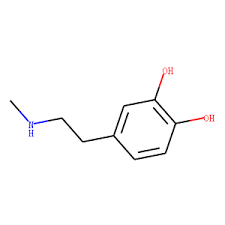
Buy Deoxyepinephrine (N-methyldopamine) Cas 501-15-5
Deoxyepinephrine, also known by the common names N-methyldopamine and epinine, is an organic compound and natural product that is structurally related to the important neurotransmitters dopamine and epinephrine. All three of these compounds also belong to the catecholamine family. The pharmacology of epinine largely resembles that of its “parent”, dopamine. Epinine has been found in plants, insects and animals. It is also of significance as the active metabolic breakdown product of the prodrug ibopamine, which has been used to treat congestive heart failure.[2][3]
Occurrence
Epinine does not seem to occur widely, but it is present as a minor alkaloid in some plants, such as the peyote cactus, Lophophora williamsii,[4] and a species of Acacia,[5] as well as in Scotch Broom, Cytisus scoparius.[6] This compound has also been isolated from the adrenal medulla of pigs and cows,[7] and from the toad, Rhinella marina.[8] It has also been detected in the locust, Locusta migratoria.[9]
Chemistry
Preparation
The first total synthesis of epinine was reported by Buck, who prepared it from 3,4-dimethoxyphenethylamine (“homoveratrylamine”) by first converting the latter to its Schiff base with benzaldehyde, then N-methylating this with methyl iodide; hydrolysis of the resulting product was followed by cleavage of the methyl ethers using hydriodic acid to furnish epinine.[10] A very similar synthesis, differing only in the use of dimethyl sulfate for the N-methylation, and HBr for the O-demethylation, but providing more extensive experimental details, was published by Borgman in 1973.[11]
An earlier semi-synthesis (so-called because it began with the natural product laudanosine) due to Pyman[1] is incorrectly cited by Buck,[10] and the error carried over to the entry for epinine (under the name deoxyepinephrine) in the Merck Index.[12]
Common salts of epinine are: hydrochloride, C9H13NO2.HCl, m.p. 179-180 °C; sulfate, (C9H13NO2)2.H2SO4, m.p. 289-290 °C;[1] hydrobromide, C9H13NO2.HBr, m.p. 165-166 °C.[11]
Reviews
There are no reviews yet.