
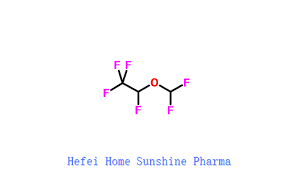
Buy Desflurane (difluoromethyl) Cas 57041-67-5
Desflurane (1,2,2,2-tetrafluoroethyl difluoromethyl ether), under the brand name Suprane, is a highly fluorinated methyl ethyl ether used for induction and maintenance of general anesthesia.[2] Desflurane was developed in the 1980s and approved by the FDA in 1992 as a faster acting and clearing inhalant anesthetic compared to previously used inhalant anesthetics.[3] Like halothane, enflurane, and isoflurane, it is a racemic mixture of (R) and (S) optical isomers (enantiomers). It has the most rapid onset and offset of the volatile anesthetic drugs used for general anesthesia due to its low solubility in blood. It is lipophobic and hydrophobic, and therefore does not easily dissolve in blood.[4]
Some drawbacks of desflurane are its low potency, its pungency, and its high cost (though at low flow fresh gas rates, the cost difference between desflurane and isoflurane appears to be insignificant[5]). It may cause tachycardia and airway irritability when administered at concentrations greater than 10% by volume. Due to this airway irritability, desflurane is infrequently used to induce anesthesia via inhalation techniques.
Though it vaporizes very readily, it is a liquid at room temperature.[6] Desflurane has a high vapor pressure and a low boiling point, requiring a specific anesthetic vaporizer.[2] Anaesthetic machines are fitted with a specialized anaesthetic vaporizer unit that heats liquid desflurane at a constant temperature and pressure.[7] This enables the agent to be available at a constant vapor pressure and negating the effects of fluctuating ambient temperatures.
Desflurane, along with enflurane and to a lesser extent isoflurane, has been shown to react with the carbon dioxide absorbent in anesthesia circuits to produce detectable levels of carbon monoxide through degradation of the anesthetic agent. The CO2 absorbent Baralyme, when dried, is most culpable for the production of carbon monoxide from Desflurane degradation, although it is also seen with soda lime absorbent as well. Dry conditions in the carbon dioxide absorbent are conducive to this phenomenon, such as those resulting from high fresh gas flows.[8]
Medical uses
Desflurane is a volatile inhalational anesthetic primarily used for the maintenance of general anesthesia in adults and for maintenance in pediatric patients after induction with other agents.[2] Desflurane is administered alongside other anesthetics like midazolam and propofol, analgesics, as well as air and oxygen for balanced anesthesia.[9] Unlike intravenous anesthetics, inhalation anesthetics allow for better and more rapid control over the concentration, therefore more control over the depth of anesthesia. In addition, elimination is more rapid, resulting in shorter spans of respiratory depression.[10] Desflurane is favored for its very rapid onset and offset of action, enabling swift induction and particularly fast recovery, which is advantageous for outpatient and day-case surgeries, and in populations where rapid emergence is critical, such as the elderly and obese patients. Desflurane has a low blood solubility because it is hydrophobic and lipophobic, which is why it has a fast onset and elimination[2] Additionally, its use has been explored in scenarios like cardiac surgery for potential myocardial protection and in cases of severe seizures in epileptic patients, but primary indications remain tied to its reliable profile for maintaining anesthesia with rapid, predictable recovery.[11][12]

Reviews
There are no reviews yet.